Fall Back, Then Set Back, and Save
When Indiana adopted daylight saving time statewide, its households started using more electricity, not less. The device that you can set back to really save energy is not a clock, but a thermostat.
If you’re reading this on the first Sunday of November, that’s a good reason to walk over to your thermostat and look at it. If its clock is an hour off, it’s probably a basic programmable thermostat that doesn’t adjust for daylight saving time, and every program it runs fires an hour early or late until someone fixes it. If the clock is right but the temperature it holds at 3 a.m. is the same as at noon and at dinnertime, it’s doing what a great many thermostats in America do: holding one number around the clock, whether anyone is home, awake, or in the room.
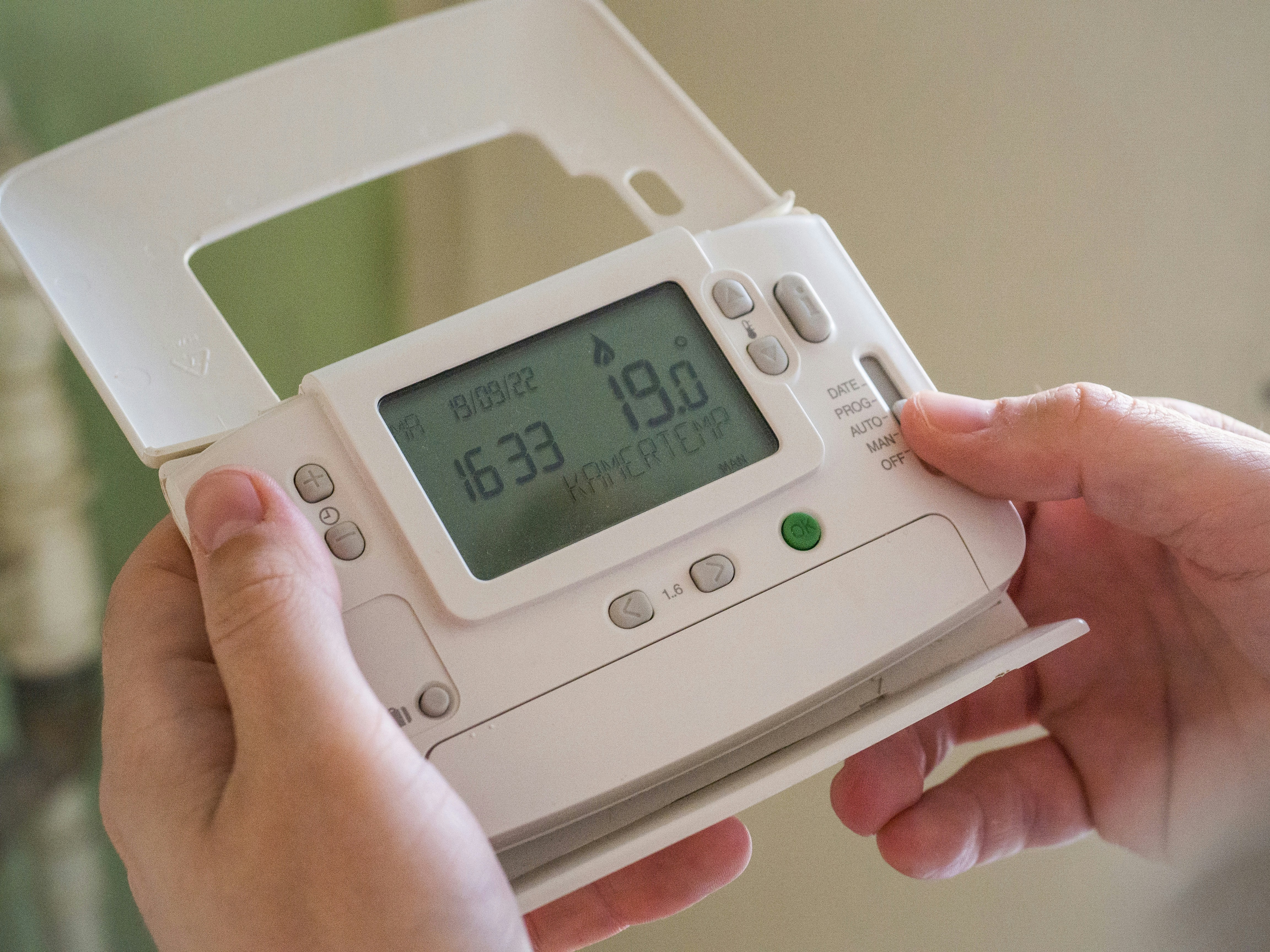
Either way, it’s worth fixing. Daylight saving clock changes make a handy reminder. Twice a year in most of the United States, on the first Sunday in November and the second Sunday in March, nearly everyone walks around the house resetting clocks. The November change arrives just as the heating season settles in for the long haul in colder parts of the United States. If you’re reading this at another time of year, don’t wait for the next clock change: a new season, a new job, or a new school schedule is just as good a reason to revisit your thermostat.
This week, we’re talking about the Energy pathway to sustainability: the practices that help you use less energy overall and shift whatever you do use toward cleaner sources. This week’s step is one of the simplest on the whole pathway: set your thermostat back when you’re asleep or away, and make sure the temperatures it holds match the hours when you actually use each space. It costs nothing, needs no contractor, and works whether you rent or own.
Join Sustainable Practice
We are transitioning to a membership model with extra benefits! Don’t miss out on additional publications, books, our archive of One Step newsletters, webinars, and belonging to the Sustainable Practitioner community! Expand your positive impact on Earth by becoming a sustainable practitioner today! www.sustainablepractice.life
Does Changing the Clock Save Energy?
While we’re talking about setbacks, let’s examine the case for daylight saving time, which comes from an era when evenings were lit by candles, lamps, and incandescent bulbs: shift the clock so people are awake during more daylight, and they’ll use less energy to see by. Congress first adopted it on March 19, 1918, to conserve fuel for the World War I effort, then repealed it in 1919 over President Wilson’s veto. It returned during World War II to save fuel again. The Uniform Time Act of 1966 made it permanent, mostly to end a confusing patchwork of local clock rules. Then, with a stated purpose of saving not just fuel but all sorts of energy, Congress stretched daylight saving time starting in 2007, moving the fall-back date from late October into November.
The evidence for energy savings has grown thinner as our homes have changed. A U.S. Department of Transportation study in the 1970s found daylight saving time trimmed national electricity use by about 1 percent. When the U.S. Department of Energy measured the 2007 extension for Congress, it found savings of about 0.5 percent on each extra day of daylight saving time, which adds up to just 0.03 percent of the nation’s electricity over a year. The savings came in the evening, partly offset by more use early in the morning.
Indiana offered a natural experiment, because only a handful of its counties observed daylight saving time until the whole state adopted it in 2006. Economists Matthew Kotchen and Laura Grant compared more than 7 million monthly household electric bills from before and after the change and found the opposite of what the policy intended: daylight saving time increased residential electricity use by about 1 percent overall, and by 2 to 4 percent in the fall. The study's results described a trade-off. Daylight time cuts lighting, but it shifts people’s routines toward colder mornings, when they turn up the heat, and hotter evenings, when they turn up the air conditioning.
Where the Energy in Your Home Actually Goes
That trade-off makes sense once you see how homes use energy today. According to the U.S. Energy Information Administration’s (EIA) 2020 Residential Energy Consumption Survey, covering all fuels, this is how energy use breaks down:
Heating and cooling: 52 percent. Space heating alone is about 42 percent, the single largest energy use in American homes. Air conditioning is about 9 percent. Homes in the Northeast and Midwest use more energy on average, mostly because they need more heat.
Water heating, lighting, and refrigeration: 25 percent together. These run all year.
Everything else: 23 percent. Cooking, clothes washers and dryers, TVs, computers, and the growing crowd of chargers and gadgets.
Artificial lighting, what daylight saving time was designed to save, is now a small and shrinking slice: about 6 percent of household electricity. The average household spent $91 on lighting in 2020, down from $147 in 2015. By 2024, nearly two-thirds of households used mostly LED bulbs indoors, up from just 4 percent in 2015.
So moving the clock nudges a small slice of your home’s energy use in the right direction, and can nudge the biggest slice in the wrong direction. Your thermostat controls that biggest slice directly.
A Thermostat Is Only as Smart as Its Schedule
Programmable thermostats have been around for decades, and the savings they promise are real. The U.S. Department of Energy estimates you can save as much as 10 percent a year on heating and cooling by turning your thermostat back 7 to 10°F for eight hours a day from its normal setting. That’s a far bigger lever than anything the clock change offers, and because heating is the biggest slice of home energy, the thermostat adjustment pays off most during the heating season.
The catch is that a thermostat only saves energy if someone tells it when to do that. When EIA asked households how they controlled their central air conditioning, more than two-thirds of those with a programmable thermostat said they never actually programmed it, and nearly half of all central-AC households said they set one temperature and left it there most of the time. The results were disappointing enough that ENERGY STAR stopped certifying programmable thermostats in 2009, because the savings weren’t showing up in real homes.
Smart thermostats were supposed to solve that. ENERGY STAR now certifies smart models based on field data from real homes, and finds they save an average of about 8 percent on heating and cooling bills. But a smart thermostat is still working from a schedule, a set of preferences, or a guess about when you’re home. If those were set up for last winter’s routine, or the installer’s defaults, or nobody at all, it’s heating your house for someone else’s life.
Match the Heat to the Hours You Use Each Space
A good winter schedule starts with a simple question: when is someone actually in this space, awake, and wanting to be warm? Answer that before you touch a button.
Sketch your week. On a scrap of paper, write down when your household typically wakes up, leaves, comes home, and goes to bed, on weekdays and on weekends. If someone works from home three days a week, or the kids have early sports practice on Tuesdays, note that too. Most thermostats allow four periods a day (wake, leave, return, sleep), and that’s usually plenty.
Pick your numbers. DOE suggests about 68°F while you’re awake and home, then the setback of 7 to 10°F while you sleep or the house is empty. If 60°F at night sounds daunting, start with a smaller drop and add a degree each week. You may find that you can go all the way into the 50s if you work up to it!
Time the warm-up, not the arrival. The “wake” period should start 30 to 60 minutes before you get up, so the house is comfortable when your feet hit the floor. Many thermostats can learn this lead time on their own; on others, you set it by trial and error over a few mornings.
Think room by room. If your home has more than one heating zone, or a ductless heat pump head in each area, give each one its own schedule. The basement family room you use only in the evening doesn’t need to be at 68°F at 7 a.m. The guest room can sit near 55°F until a guest arrives. A home office needs heat on workdays and much less on Saturday when you’re out of the house. With radiators, baseboards, or ductless heads, closing the doors to rooms you aren’t using keeps the warmth where people are. With a central ducted system, leave doors and supply vents open, because closing them can throw off the system’s airflow.
Whatever Is on Your Wall, Here’s How to Get It Right
If you have a smart thermostat, open its app and look at the schedule as if you’d never seen it before. Is it still built around last winter’s routine, or around a default someone else chose? Check that its away setting or eco setting actually lowers the temperature, and that the setback is deep enough to matter. If it uses your phone’s location to tell when you’ve left, make sure every adult in the household is connected, or it may decide the house is occupied when only a phone left on the counter is home. And glance at the monthly energy report. If your smart thermostat has quietly “learned” its way up to 72°F, now is the time to teach it otherwise.
If you have a basic programmable thermostat, start with the clock. Set the correct time and day, and check whether it has an automatic daylight saving setting. Older models built before the 2007 change to U.S. daylight saving dates may follow the old calendar, which would have moved the clock a week early, on the last Sunday of October. If yours did, turn the automatic setting off and adjust it by hand twice a year. Then program both weekdays and weekends from the schedule you sketched. Make sure the thermostat isn’t stuck on a permanent “hold,” which overrides every program you set. If the batteries are more than a year old, replace them so the schedule doesn’t vanish in the middle of the season.
If you have a manual thermostat, the setback still works; you just do it yourself. Turn the dial down at bedtime and back up when you wake, and down again when the last person leaves for the day. Tie it to something you already do every night, like locking the front door. If that habit doesn’t stick, consider an upgrade: many utilities offer rebates on ENERGY STAR certified smart thermostats, sometimes enough to cover much of the price.
If you heat with a heat pump, don't go too far with setbacks. DOE cautions that deep setbacks can backfire with a heat pump in heating mode, because recovering from a cold house can call on backup electric resistance heat, which costs far more to run. A thermostat with adaptive recovery brings the temperature back up gradually using the heat pump alone. Without one, keep the setback to a few degrees or hold a steady temperature, which many cold-climate heat pump owners find is the comfortable and efficient default. DOE also notes that steam and radiant floor systems respond slowly, sometimes taking hours to recover, so they’re best with modest, well-timed setbacks or none at all.
A Side Step for Your Outdoor Lights
Outdoor lights deserve a look whenever the clocks change, too. In the fall, sunset jumps an hour earlier overnight and keeps creeping earlier until mid-December; in the spring, it jumps an hour later. Any outdoor light on a fixed schedule set months ago is probably running at the wrong hours. Pick the side step that fits where you are.
If your outdoor lights run on a wall switch (or on whoever remembers), put them under automatic control. A photocell, or dusk-to-dawn sensor, turns a light on when it gets dark and off when it gets light, and DOE notes these sensors suit all kinds of outdoor lighting. Many fit existing fixtures, and screw-in versions are available. An astronomical timer does the same job by calculating sunrise and sunset for your location every day, and it can also switch lights off at a set hour. DOE cautions that ordinary timers usually aren’t the best choice for outdoor lights on their own, because they need resetting as nights lengthen and shorten.
If your lights already turn on by themselves, check that the hours they’re on match the hours they actually help someone. A porch light earns its keep while people are arriving and leaving, not at 3 a.m. Path and landscape lights can go off once the last person is home. Decorative lights can go off at bedtime. For security, motion sensors light the yard the moment someone is there, rather than all night for no one. Every hour a light stays off saves electricity and gives back a little darkness to the night sky and the birds, moths, and other wildlife that depend on that darkness.
Your One Step This Week
Spend some time this week with your thermostat. (If you’re reading this around the November clock change, you’ve got an extra hour in your day, so no excuses!) Fix its clock if it needs fixing. Then sketch your household’s week, decide which spaces you use and when, and program a heating-season schedule that holds about 68°F when people are home and awake, and sets back 7 to 10°F overnight and whenever the house is empty. Heat pump households: keep the setback modest. Manual-dial households: make the bedtime turn-down a nightly habit. If you’re reading this in cooling season, flip the logic: DOE suggests about 78°F when you’re home, set 7 to 10°F higher when you’re away. Then, if you have outdoor lights, take the side step above: put them on a photocell or astronomical timer, or trim their hours to the times they actually help.
When you’re done, write the schedule down in your home manual if you keep one, or on an index card taped inside a cabinet door. Then set a calendar reminder for the next clock change to check the thermostat’s clock and adjust the schedule for the new season.
For more on choosing temperature settings and dozens of other science-based practices, explore Sustainable Practices: Your Handbook for Effective Action, which can be ordered at https://www.SustainablePractice.Life and explore the related articles below.
Sustainable Practice empowers you to protect our planet in practical ways. Share this article with the person in your household who always fixes the microwave clock. Next time, have them adjust the thermostat, too.
Note: How does Sustainable Practice use AI? We use machine intelligence for research so that our materials are more trustworthy, not less. We never publish anything we haven't personally reviewed, edited, and written to our standards and specifications. You can trust our human use of current resources, our 30+ years of lived experience in the sustainability field, and our judgment of the science we rely on.
Fred Horch and Peggy Siegle, Principals, Sustainable Practice
References and Resources
Programmable Thermostats — U.S. Department of Energy, Energy Saver (up to 10 percent annual savings from a 7–10°F setback for 8 hours a day; cautions for heat pumps, steam, and radiant floor systems)
How Thermostat Setbacks Save Money — This Old House (summary of DOE guidance: about 68°F while awake in winter, 7–10°F lower while asleep or away)
Few U.S. Homes Choose to Program Their Thermostats — U.S. Energy Information Administration, Today in Energy (2015 RECS: more than two-thirds of central-AC households with programmable thermostats don’t program them; 45 percent set one temperature and leave it; ENERGY STAR dropped programmable thermostats in 2009)
Space Heating Consumed the Most Energy of Any End Use in Homes — U.S. Energy Information Administration (space heating was 42 percent of residential energy consumption in the 2020 RECS)
ENERGY STAR Certified Smart Thermostats: Technical Bulletin — U.S. EPA ENERGY STAR (certification based on field data; average savings of 8 percent on heating and cooling, about $50 a year)
Thermostat Controls — Pacific Northwest National Laboratory / DOE Building America Solution Center (adaptive-recovery thermostats minimize costly auxiliary resistance heat in heat pump homes)
Daylight Saving Time Rules — National Institute of Standards and Technology (DST begins at 2 a.m. on the second Sunday of March and ends at 2 a.m. on the first Sunday of November; NIST time services send UTC and leave DST to each device’s software; clocks made before the 2007 rule change may switch on the old dates)
Why Do We Have Daylight Saving Time? — History.com (energy conservation behind the World War I origins; the 1966 Uniform Time Act standardized a patchwork of local schedules)
World War I and Daylight Saving Time — Library of Congress (first U.S. daylight saving law passed March 19, 1918, to conserve fuel for war industries; repealed August 20, 1919; revived in 1942)
100 Years Ago: Daylight Savings — Geneva Historical Society (Congress repealed daylight saving in 1919 by overriding President Wilson’s veto; Uniform Time Act of 1966)
Energy Policy Act of 2005: US Daylight Saving Time Changed — timeanddate.com (moved the end of DST from the last Sunday of October to the first Sunday of November, effective 2007)
Impact of Extended Daylight Saving Time on National Energy Consumption: Report to Congress — U.S. Department of Energy, 2008 (0.5 percent electricity savings per extended day; 0.03 percent over the year; small early-morning increases)
Does Daylight Saving Time Save Energy? Evidence from a Natural Experiment in Indiana — Matthew Kotchen and Laura Grant, published in The Review of Economics and Statistics (2011) (DST raised residential electricity use about 1 percent, 2 to 4 percent in the fall)
Does Daylight Saving Time Conserve Energy? — Scientific American (1970s DOT study found about 1 percent national electricity savings; heating and cooling explanation for the Indiana result)
Use of Energy in Homes — U.S. Energy Information Administration, Energy Explained (2020 RECS: 52 percent heating and cooling; 25 percent water heating, lighting, and refrigeration; 23 percent everything else)
How Much Electricity Is Used for Lighting? — U.S. Energy Information Administration (lighting about 6 percent of household electricity in 2020)
LED Bulbs in U.S. Homes, 2024 — U.S. Energy Information Administration, Today in Energy (households using mostly LED bulbs rose from 4 percent in 2015 to 63 percent in 2024)
Lighting Controls — U.S. Department of Energy, Energy Saver (photosensors suit outdoor lighting; plain timers need frequent resetting as the length of night changes)
Use Advanced-Technology Lighting Outdoors — We Energies (astronomic timers turn lights on at dusk and off at dawn)
Related One Step Articles
Your New Year’s Energy Resolution: Smart Temperature Settings — Sustainable Practice, One Step This Week (a deeper look at choosing your thermostat settings)
The Warmest Air in Your House Is Trapped at the Ceiling — Sustainable Practice, One Step This Week (a ceiling fan trick that makes a lower setpoint feel warmer)
Close the Window You Didn’t Know Was Open — Sustainable Practice, One Step This Week (sealing drafts so the heat you schedule stays inside)
Your Home Deserves a Manual — Sustainable Practice, One Step This Week (a place to record the thermostat schedule you set)
A Switch You Can Flip Tonight to Save Migrating Birds — Sustainable Practice, One Step This Week (why outdoor lights-out times matter beyond the electric bill)