A Switch You Can Flip Tonight to Save Migrating Birds
Most songbirds migrate after dark—turning lights off at night is the simplest help you can offer to keep them on course
On spring nights this time of year, the skyway above your house is busier than the roadway in front of it. Millions of warblers, thrushes, orioles, tanagers, and sparrows are passing overhead after sunset and before sunrise, navigating by stars and the Earth’s magnetic field on their way to nesting grounds in northern latitudes. You can’t see them from the light on your porch, but unfortunately, they can see your porch light. Artificial light draws migrating birds out of the dark sky, where they circle until exhausted or collide with windows. A helpful step you can take this week to recognize World Migratory Bird Day (which was yesterday, May 9) is to leave lights off.
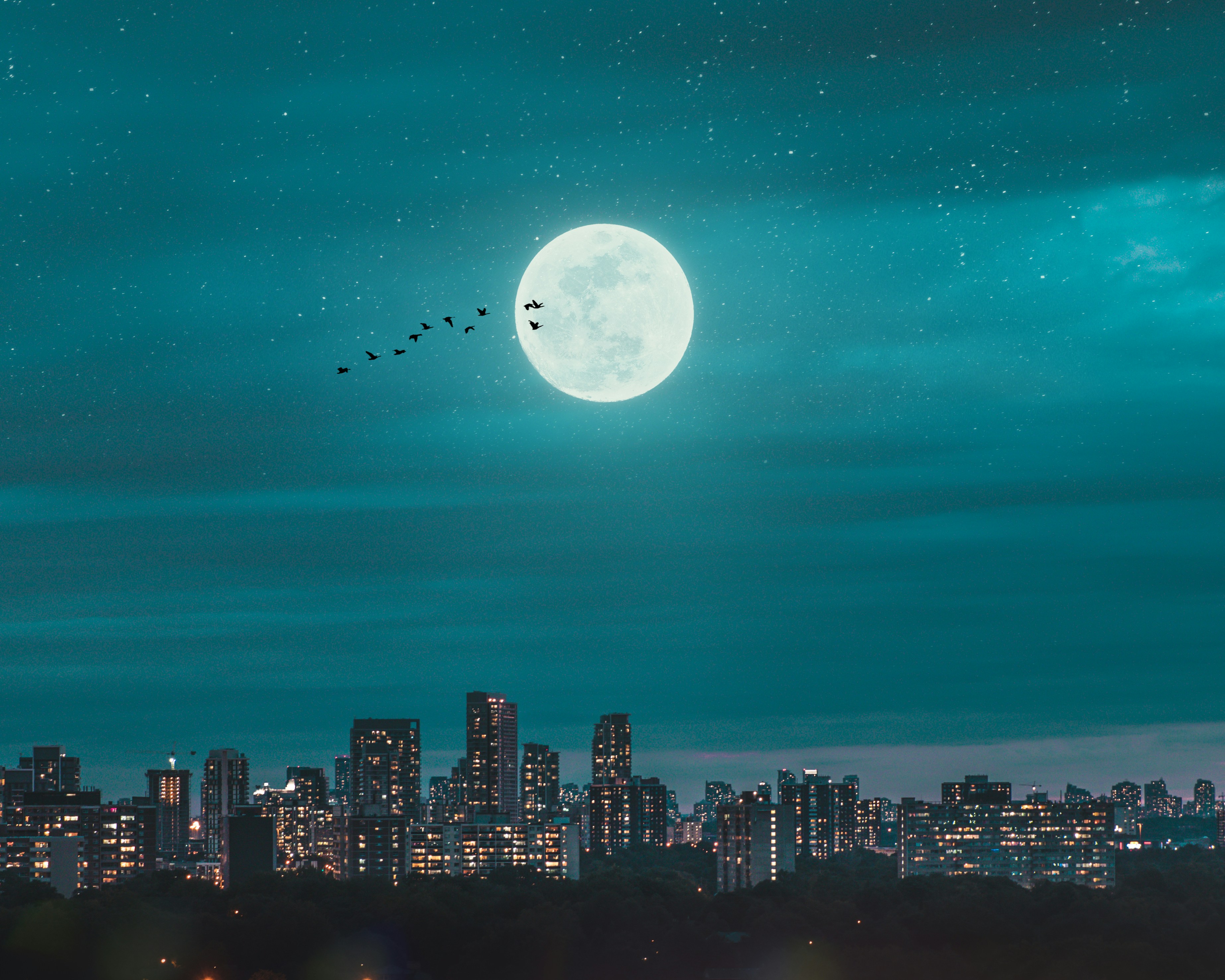
Roughly 80 percent of migratory bird species in North America travel at night, according to the National Audubon Society. They evolved to use the moon, the stars, and a magnetic compass embedded in their eyes—cues that worked beautifully until human-invented light at night arrived a century ago and began rewriting the rules. Today, it’s estimated that up to a billion birds die from collisions with buildings each year in the United States. The biggest problem is not skyscrapers but ordinary low-rise commercial buildings and homes, because there are so many of them.
This week, we’re walking the Habitat pathway—the set of sustainability practices concerned with our buildings, our land, and the natural world around us. Habitat work isn’t only about what you plant or where you build; it’s also about what you do day to day. Sometimes the most powerful step is subtraction: a light not left on to compete with the moon and the stars at three in the morning.
What the Science Actually Shows
The most rigorous evidence that you can save birds by turning off lights comes from Chicago, where ornithologists at the Cornell Lab of Ornithology, the Field Museum, and partner institutions analyzed twenty-one years of bird-collision data at McCormick Place, a single large convention center on the Lake Michigan shoreline. The Field Museum’s bird division had been collecting and cataloging the birds that died there since the 1980s. When the building reduced its overnight lighting, the body counts dropped. When it left the lights on, they spiked.
In a 2021 paper published in the Proceedings of the National Academy of Sciences, Benjamin Van Doren and colleagues found that on nights when half the windows at McCormick Place were dark, there were eleven times fewer fatal collisions during spring migration and six times fewer during fall migration than on nights when all the windows were lit. Halving the lighted area cut spring mortality by about 59 percent. The effect was strong enough that lighting was the single biggest predictor of collisions on a given night—larger than weather, larger than wind direction, larger than the total number of birds in the air. As Van Doren put it in the press release accompanying the study: “We can save birds simply by turning off lights during a handful of high-risk days each spring and fall.”
A separate 2023 study in Nature Communications, led by Kyle Horton at Colorado State University, used continent-wide weather radar data to ask a different question: where do migrating birds land to rest during the day? The answer was unsettling. Light pollution was a better predictor of stopover density than tree cover, temperature, or rainfall. City lights are pulling birds out of the sky and depositing them in some of the worst possible places to refuel—paved, predator-rich, food-poor environments where collisions, cats, and exhaustion all wait. Horton’s team called this an “ecological trap.”
The bright side (please pardon the pun) is that the fix is immediate. Birds who are still alive haven’t been damaged by yesterday’s light. As Horton said in the same paper’s coverage: “If we turned off all lights tonight, there would be no birds colliding because of lights tonight.” An instant, money-saving fix isn’t possible for most environmental problems. It is for this one.
Your One Step This Week
Between roughly 11 PM and 6 AM, for the next three to four weeks of peak spring migration, leave non-essential lighting off—both inside and outside your home. That’s it. The Audubon Society and most state-level Lights Out programs recommend the same time period: late evening through dawn, during the migration season of your region. In the eastern and central United States, peak spring migration runs roughly from late April through the third week of May. In the West and along the Gulf Coast, the timing shifts a little, but the second week of May is squarely in the busy season almost everywhere.
A few specifics that matter:
Outdoor decorative lighting (landscape spotlights, uplit trees, garden path lights, lit flagpoles) is the single highest-impact target. Most of it serves aesthetics rather than safety, and most of it points up or out, exactly where birds can see it. Turn it off during migration season, or put it on a timer that shuts down at 11 PM.
Upper-floor interior lights are visible to birds for miles when curtains are open. If you’re not in the room, turn the lights off—or at least pull the blinds tightly closed.
Porch and security lights can stay functional. Switch them to motion sensors, aim them downward, and use warm-color bulbs (under 3000K). Steady all-night floodlights are what cause the trouble, not a porch light that flicks on when someone walks up.
Holiday and seasonal lighting is worth retiring during migration. Mother’s Day weekend is a fine time to box up the last of the spring decorations.
If you want to go a step further—and if you noticed that this year’s World Migratory Bird Day theme is “Every Bird Counts: Your Observations Matter”—two free tools can expand your positive impact. The first is BirdCast (birdcast.info), a project of the Cornell Lab of Ornithology, Colorado State University, and the University of Massachusetts Amherst. BirdCast uses NEXRAD weather radar to forecast the next three nights of migration anywhere in the contiguous United States and issues “Lights Out alerts” on heavy nights. You can check it the way you check the weather. On nights when hundreds of millions of birds are aloft over your state, you’ll know to be especially careful.
The second is eBird (ebird.org), also from the Cornell Lab, where you can log the birds you see in your own yard. Your sightings join a continental dataset that ornithologists use to track migration timing, range shifts, and population trends. Mother’s Day weekend is, statistically, one of the best birding weekends of the year in much of North America. A walk in the yard with a notebook—or with the free Merlin Bird ID app to identify songs—is a small contribution to the largest bird database ever assembled.
A Word About the Mothers Overhead
Many of the birds passing over your roof tonight are mothers-to-be racing toward nesting grounds where, in the next few weeks, they’ll build a cup of grass and lichen the size of a teacup, lay four eggs in it, and feed their young by capturing thousands of caterpillars from the surrounding trees. A migrating warbler that gets pulled off course, circles a lit gas station until dawn, and dies exhausted to be eaten by a stray cat is a season’s worth of birdsong that won’t happen, and a tree’s worth of caterpillar control that won’t get done.
If you’ve made your windows bird-safe (see Save a Bird Today: The Window Fix Anyone Can Do), you’re already most of the way to a home that helps rather than harms the birds passing through. Your next decision—do you leave the patio lights on tonight or not—takes about three seconds. But across millions of houses, those three-second decisions add up to the difference between three billion birds lost in the next few years or a continent ringing with birdsong.
References and Resources
Primary Research
Van Doren, B.M., Willard, D.E., Hennen, M., Horton, K.G., Stuber, E.F., Sheldon, D., Sivakumar, A.H., Wang, J., Farnsworth, A., & Winger, B.M. (2021). Drivers of fatal bird collisions in an urban center. Proceedings of the National Academy of Sciences, 118(24), e2101666118. https://www.pnas.org/doi/10.1073/pnas.2101666118
Horton, K.G., Buler, J.J., Anderson, S.J., Burt, C.S., Collins, A.C., Dokter, A.M., Guo, F., Sheldon, D., Tomaszewska, M.A., & Henebry, G.M. (2023). Artificial light at night is a top predictor of bird migration stopover density. Nature Communications, 14, 7836. https://pmc.ncbi.nlm.nih.gov/articles/PMC10696060/
Rosenberg, K.V., Dokter, A.M., Blancher, P.J., Sauer, J.R., Smith, A.C., Smith, P.A., Stanton, J.C., Panjabi, A., Helft, L., Parr, M., & Marra, P.P. (2019). Decline of the North American avifauna. Science, 366(6461), 120–124. https://www.science.org/doi/10.1126/science.aaw1313
Practical Tools
BirdCast — Bird Migration Forecasts and Lights Out Alerts
https://birdcast.org/
eBird — Submit Your Observations
https://ebird.org
Merlin Bird ID — Free Sound and Photo Identification App (Cornell Lab of Ornithology)
https://merlin.allaboutbirds.org
Lights Out Programs and Guidance
National Audubon Society — Lights Out Program (find your local program and download letter templates)
https://www.audubon.org/our-work/cities-and-towns/lights-out
U.S. Fish & Wildlife Service — World Migratory Bird Day 2026
https://www.fws.gov/story/2026-01/world-migratory-bird-day-2026
DarkSky International — Five Principles for Responsible Outdoor Lighting
https://darksky.org/resources/guides-and-how-tos/lighting-principles/
Related One Step Articles
Save a Bird Today: The Window Fix Anyone Can Do — bird-safe window treatments
https://sustainablepractice.life/archive/2026-03-01-save-a-bird-today-the-window-fix-anyone-can-do
Lighting the Way: Your Complete Guide to Sustainable Illumination — choosing bulbs, fixtures, and settings that work for people and wildlife
https://sustainablepractice.life/archive/2025-11-23-lighting-the-way-your-complete-guide-to-sustainable-illumination
Join our Community of Sustainable Practitioners
Sustainable Practice
www.sustainablepractice.life