What’s Pilfering the Perseids
Every August, one of the year’s best meteor shows is invisible to most people in America — not because of clouds, but because of our own misguided outdoor lights.
On the night of August 12 into 13, Earth passed through a dense debris trail left by Comet Swift-Tuttle, creating one of the best natural light shows of the year: the Perseid meteor shower. The 2026 event was especially favorable, with a new moon offering no competing moonlight. This is a coincidence that doesn’t happen every year. Under a genuinely dark sky, observers could see 50 to 75 meteors an hour, with occasional fireballs that leave glowing trails for several seconds. But most people in the United States and Canada wouldn’t know that, because the sky above most of our neighborhoods is never actually dark.
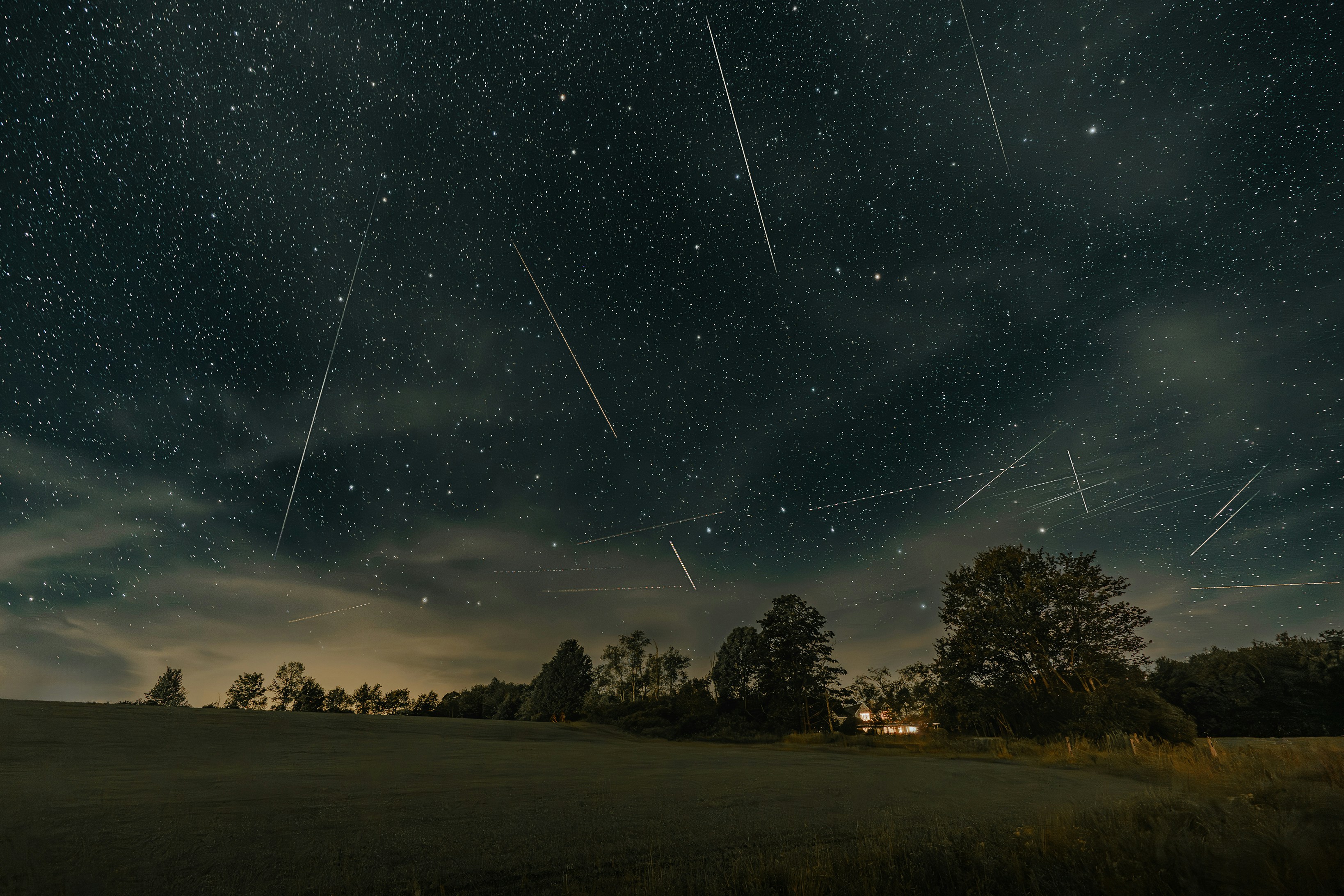
More than 99 percent of people in the United States and Europe live under light-polluted skies, according to a landmark 2016 satellite study published in Science Advances. The glow above a typical suburb is a shared responsibility, the cumulative output of tens of millions of outdoor fixtures, many of them poorly aimed, running all night for no reason, and far brighter than necessary. Besides making it impossible to enjoy the night sky, the electricity required to run these lights represents a colossal waste of money and resources. Unfortunately, our problem is getting worse: citizen-scientist observations show the night sky brightening by nearly 10 percent per year.
This is primarily a Habitat pathway issue, one of the seven pathways defined by Sustainable Practice that together describe how we can protect what makes Earth livable. The Habitat pathway encompasses our buildings, our land, and the natural systems around us, including the night sky, which is habitat for migrating birds, insects, sea turtles, and many other species that evolved to navigate by starlight and moonlight. Light pollution is also an energy issue: DarkSky International estimates that roughly 30 percent of all outdoor lighting in the U.S. is wasted. It goes up, sideways, or into spaces where no one needs it, and, worse, it can cost about $3.3 billion a year and 21 million tons of unnecessary carbon dioxide emissions.
The one step this week is to audit your own outdoor lighting with fresh eyes, and then, if you’re up for it, to talk with a neighbor about their outdoor lighting that affects you.
What Light Pollution Does
The problem with outdoor lighting isn’t that it exists. It’s that most fixtures are doing several harmful things at once: running longer than necessary, shining brighter than necessary, and sending a significant fraction of their light sideways or upward where it illuminates nothing useful, contributing to the glow that washes out the stars and meteors.
It’s not just humans who bear the cost of all that waste. Wildlife suffers too. A 2025 review in Frontiers in Ecology and the Environment examined how 136 animal species respond to natural light cycles and found that 85 of them are affected by artificial light bright enough to mimic a full moon every single night, permanently — and that light pollution has already doubled the brightness of new-moon nights across 23 percent of Earth’s land surface. Fireflies can’t find their mates in the glare. Frogs stop calling. Insects that use the moon and stars to navigate are drawn to bright fixtures instead, where they exhaust themselves circling until they die, thereby removing a food source for the bats and birds that depend on them.
For migratory birds, the stakes are especially dire. Roughly 70 percent of North American bird species migrate, and about 80 percent of those travel at night, navigating by stars and Earth’s magnetic field. Artificial light draws them off course. The U.S. Fish and Wildlife Service notes that lighting can attract night-migrating birds from as far as five kilometers away. Once drawn in, they circle lit areas, burning the energy reserves they need to complete their journey, and colliding with buildings at rates researchers have only recently begun to quantify systematically. A widely cited 2014 analysis in The Condor estimated that building collisions kill between 365 million and nearly a billion birds a year in the United States, making buildings the second-largest source of direct human-caused bird deaths after outdoor cats. A 2021 study of a single Chicago convention center found that cutting a building’s lit window area to the lowest levels recorded over two decades could reduce collisions there by roughly 60 percent; even a simple halving of the lit window area cut spring collisions several-fold.
Starting at Home
The most effective thing you can do before talking to anyone else is to fix your own lights. Your property can become a beacon of responsible outdoor lighting. And personal experience gives you real answers when a neighbor asks how they can change.
Here’s how to start. Stand in your yard after dark and carefully inspect each of your outdoor fixtures. Ask these questions:
Does this light need to be on all night, or would a motion sensor be an improvement? Motion-activated lights save energy, last longer, and they’re also better for security. The motion that triggers them alerts you to intruders and alerts intruders that their movements are being detected, deterring many would-be thieves.
Is this light brighter than it needs to be? In many outdoor fixtures, you can swap in a lower-wattage bulb. The lower the wattage, the less electricity you are using.
Where is the light actually going? A fixture that sends light in all directions, such as a globe, a lantern, or an unfocussed spotlight, scatters light up and sideways where it does no useful work. A well-shielded fixture blocks light from escaping above the horizontal plane. Shielded replacements are available at every price point; if a fixture is aging, it’s worth choosing one, and DarkSky International maintains a directory of independently certified fixtures for added assurance.
What color is the light? Outdoor LEDs often default to a “cool” bluish-white (5000–6500K on the color temperature scale) that is harder on wildlife and on human eyes than “warm” amber light. Widely used guidance from DarkSky International and the Illuminating Engineering Society calls for color temperatures no higher than 3000K, with 2700K or lower preferred near ecologically sensitive areas. Sometimes swapping bulbs to a warmer color doesn’t require replacing the fixture.
When is the light on? The worst case is lights that are on all the time, even during the day. Once you start noticing them, you’ll spot a surprising number of outdoor lights that are wasting electricity even during the middle of the day. But outdoor lights on simple dusk-to-dawn sensors that run all night even when no one is home, no one is in the yard, and nothing is happening aren’t great, either. A timer set to shut off at 11 PM — or a motion sensor that activates only on demand — is one of the simplest fixes available. Make this upgrade, and you’ll see an immediate positive effect on both your electricity bill and the sky above your house.
Talking to Your Neighbors
Once your own fixtures are sorted, you’re in position to have a friendly conversation with a neighbor whose lights are spilling onto your property or brightening the sky above your street. Know this before you start: almost no one installs a glaring outdoor fixture on purpose. People buy what’s at the hardware store, use it because it was there when they moved in, or assume that brighter and whiter means safer. Conversations work best when they start from the assumption of goodwill.
DarkSky International — the leading organization on light pollution, formerly called the International Dark-Sky Association — offers guidance on approaching neighbors about their lights, built around the idea that most people don’t realize their lighting is causing a problem. Its core advice: go to the conversation with solutions already in hand, not just a complaint. Know exactly what you’d recommend they buy or do differently if they’re willing to make a change, and offer to help install it. Lead with the benefits to them — lower electricity costs and a less intrusive light that won’t bother their own sleep or their own view of the sky. Notably, research has not found a consistent link between brighter lighting and reduced crime; glare from an unshielded fixture can actually make it harder to see potential hazards, while a properly shielded, downward-aimed light can improve visibility at ground level by cutting glare. Avoid leading with a lighting ordinance, even if one exists, or with the threat of legal action — DarkSky’s own guidance treats that as a last resort that tends to create lasting conflict rather than solve the problem.
An invitation is often more effective than a criticism. Ask your neighbor to stand on your property and look at their light from your perspective. Many people genuinely don’t know what their own fixtures look like to someone else. A stargazing night in your yard when you can point out the Milky Way if it’s visible, or count the stars in a given patch of sky, can do more to build motivation than any number of facts about wildlife.
If you want to go beyond a single neighbor, DarkSky International offers free policy templates for municipal and state outdoor lighting codes, built on the same principles, for residents who want to present a proposal to a city council or planning board.
Your one step this week
Go outside tonight, after dark. Look at your own outdoor lights. See if there is anything you can improve: a bulb down to a warmer, lower-output option; a dusk-to-dawn sensor switched to a timer or a motion sensor; a fixture replaced with a shielded one. Then, if you have a neighbor whose lights are particularly bright or poorly aimed, set up a time this week to talk with them — with an offer to share information rather than a grievance.
The Perseids will be back next August. If you missed 2026, you don’t have to miss 2027, especially if you and your neighbors all make positive changes so the sky above your street is darker.
For deeper guidance on the Habitat and Energy pathways, including dozens of specific practices for lighting, land use, and protecting the natural world around your home, visit www.suspra.com or pick up Sustainable Practices: Your Handbook for Effective Action at https://www.SustainablePractice.Life. The related articles below will also help you build on this step.
Note: How does Sustainable Practice use AI? We use AI for research so that our materials are more trustworthy, not less. In no case do we publish anything we have not personally reviewed, edited, and written to our standards and specifications. You can trust our human use of current resources, our 30+ years of lived experience in the sustainability space, and our judgment of the science on which we rely.
References and Resources
The New World Atlas of Artificial Night Sky Brightness — Falchi, F. et al., Science Advances (2016) — more than 99% of the U.S. and European populations, and over 80% of the world, live under light-polluted skies.
Global artificial light masks biologically important light cycles of animals — Seymoure, B.M. et al., Frontiers in Ecology and the Environment (January 2025), DOI: 10.1002/fee.2832 — of 136 animal species reviewed, 85 are affected by light levels between full moon and nautical twilight; light pollution has doubled new-moon brightness across 23% of Earth’s land surface.
Citizen scientists report global rapid reductions in the visibility of stars from 2011 to 2022 — Kyba, C.C.M. et al., Science (2023) — analysis of 51,000+ citizen observations found sky brightness increasing by roughly 9.6% per year globally.
Threats to Birds: Collisions (Nighttime Lighting) — U.S. Fish & Wildlife Service — lighting can attract migrating birds from as far as 5 km away; birds circle and exhaust themselves or collide with buildings.
National Audubon Society and DarkSky International Partner to Protect the Night Sky for Birds and People — Audubon (2023) — 70% of North American bird species migrate, and 80% of those migrate at night.
Bird–building collisions in the United States: Estimates of annual mortality and species vulnerability — Loss, S.R., Will, T., Loss, S.S., & Marra, P.P., The Condor 116(1):8–23 (2014) — estimates 365 million to 988 million (median 599 million) annual U.S. bird deaths from building collisions.
Drivers of fatal bird collisions in an urban center — Van Doren, B.M. et al., Proceedings of the National Academy of Sciences (2021) — at one heavily monitored Chicago building, reducing lit window area to the lowest levels recorded over 20 years was projected to cut collisions there by roughly 60%; halving the lit window area alone cut modeled spring collisions roughly 11-fold.
Five Principles for Responsible Outdoor Lighting — DarkSky International — the framework underlying responsible outdoor lighting: useful, targeted, low level, controlled, warm-colored.
Dark sky-friendly outdoor lighting for policymakers — DarkSky International — at least 30% of U.S. outdoor lighting is wasted, costing $3.3 billion and releasing 21 million tons of CO₂ annually; no consistent evidence links brighter lighting to reduced crime.
How to Keep Skies Dark at Night — Architect magazine — an architectural-design perspective on the same 30%/$3.3 billion waste estimate, plus IDA/IES color-temperature guidance (below 3000K).
My neighbor’s lighting: What can I do? — DarkSky International — practical, empathy-first guidance for approaching neighbors about intrusive outdoor lighting, including a sample letter.
Neighborhood-friendly lighting: Model guidance for Homeowners Associations (HOAs) — DarkSky International — the Five Principles adapted for community-level implementation.
Create state and local outdoor lighting codes — DarkSky International — free template municipal and state lighting-code language for residents and advocates.
The Perseid meteor shower 2026: How to watch — The Planetary Society — 2026 peak the night of August 12–13; new moon conditions; 50–75 meteors per hour from a dark site.
Related One Step Articles
A Switch You Can Flip Tonight to Save Migrating Birds — Sustainable Practice, One Step This Week (the case for turning off non-essential lights during migration season, with the science behind it)
Your Windows Are Invisible Deadly Walls to Birds — Sustainable Practice, One Step This Week (bird-safe window treatments: what works, what doesn’t, and how to apply it)
The Other 4,000 Bees — Sustainable Practice, One Step This Week (light pollution disrupts native pollinators too; this piece covers habitat for ground-nesting bees that share the darkness with nocturnal insects)
Join Sustainable Practice
Expand your positive impact on Earth by becoming a sustainable practitioner today! www.sustainablepractice.life
Sustainable Practice empowers you to protect our planet in practical ways. If someone you know missed the Perseids this week, share this article and help them see what a darker yard could open up.