The Other 4,000 Bees
Honey bees aren’t native to North America—but wild bees that are will pollinate your tomatoes better, if you give them a place to live in your yard or on your balcony
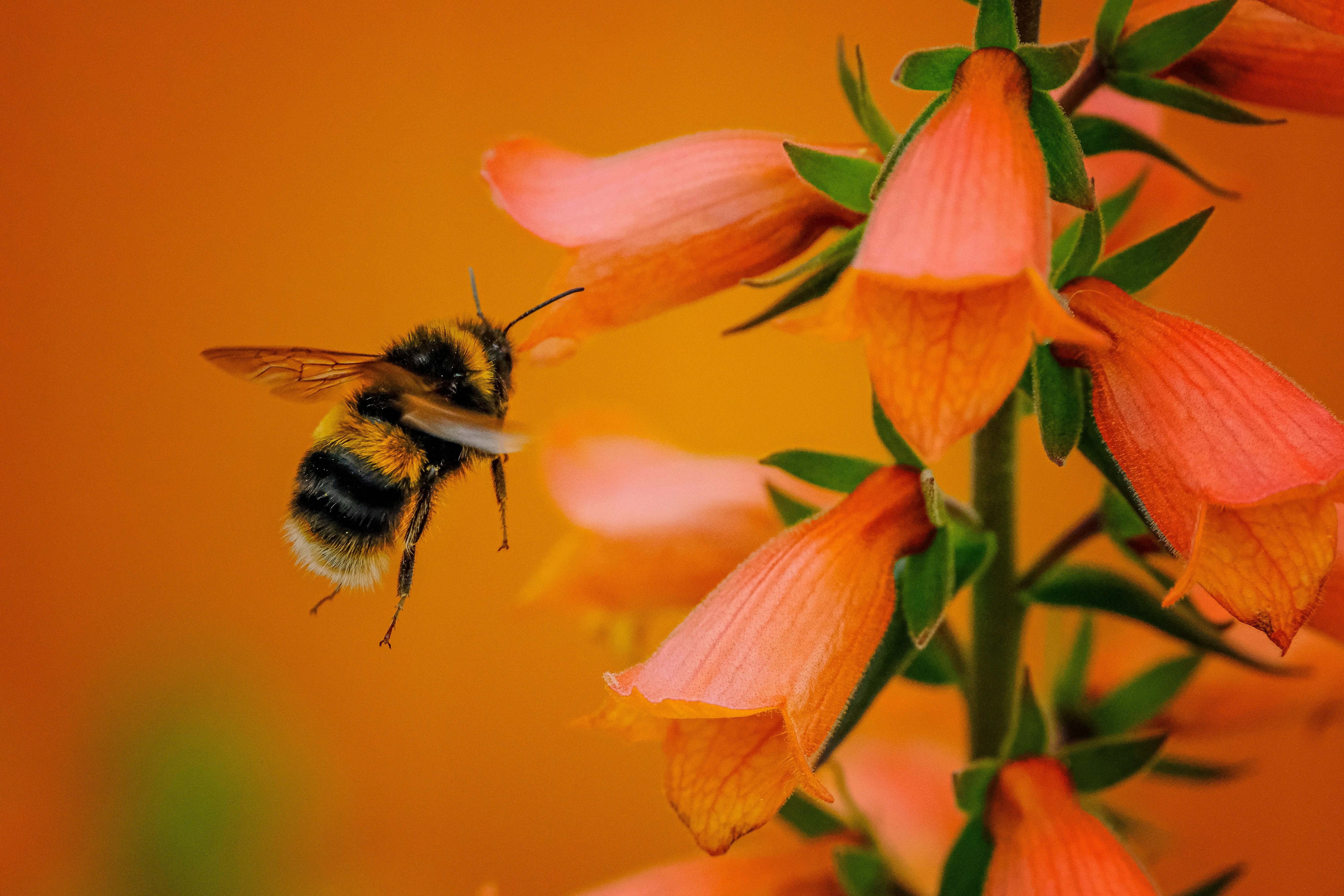
If you've eaten a blueberry, a tomato, a squash, or an apple lately, a wild bee almost certainly had something to do with it—and that bee was probably not a honey bee. Honey bees (Apis mellifera) are European livestock, brought over by colonists in the 1620s. The continent they arrived on already had its own pollinators: roughly 4,000 native bee species, most of them solitary, most of them nesting in the ground or in hollow stems, and many of them better at pollinating the plants that evolved here than the honey bee will ever be. World Bee Day is this Wednesday, May 20, and it’s a good moment to widen the lens beyond hives and honey to the much larger story of native pollinators—because the best step you can take for bees this week is not buying a hive or honey. It’s providing native bees with a place to nest.
We’re walking the Habitat pathway again this week, the set of practices concerned with our buildings, our land, and the natural world we share with everything else that lives here. Last week, the Habitat step was subtraction: turning off lights for migrating birds. This week’s step is provision—leaving a patch of yard available for nests for native bees, creatures most of your neighbors might never notice.
Why Native Bees, Not Just Honey Bees
The U.S. Geological Survey estimates there are about 4,000 native bee species in the United States, ranging from the two-millimeter Perdita minima (the world’s smallest bee) to carpenter bees the size of a kumquat. Many are striped, but plenty are metallic green, iridescent blue, or matte black. Some are so small you’d mistake them for fruit flies. Together, these species pollinate roughly 80 percent of the world’s flowering plants, including about 75 percent of native North American plants and many of the crops we eat.
Honey bees, in contrast, are one species. They’re excellent generalists, they work together in hives, they make honey, and they’re indispensable for almonds and a few other large monocultures. But for many flowers, a honey bee visit is less productive than a visit by a native bee. A long-running study at Cornell, led by entomologist Bryan Danforth, found that native bees are two to three times more effective per visit for apple pollination than honey bees. The reasons are mechanical: most native bees carry pollen in dry, fuzzy patches across their bodies, scattering it loosely as they move from flower to flower, while honey bees pack pollen into tidy, moistened bundles on their hind legs that don’t rub off as easily.
Tomato, blueberry, and cranberry flowers add another twist—they release pollen only when vibrated at the right frequency, a trick called “buzz pollination” that bumblebees and many other native bees can perform but honey bees cannot. This specific biological limitation is exactly why commercial greenhouse tomato growers rely almost entirely on raised bumblebee colonies rather than on commercial honey bee hives to pollinate their crops.
This matters because, while honey bee colonies have made headlines for decades, native bees have been quietly disappearing with far less attention. The rusty patched bumble bee (Bombus affinis), once one of the most common bumblebees in the eastern United States and a major pollinator of cranberries, blueberries, and apples, has been lost from roughly 87 percent of its historic range and was listed as endangered in 2017—the first bee in the continental U.S. to receive Endangered Species Act protection. More than a quarter of North American bumblebee species are now considered at risk of extinction, according to the Xerces Society. Habitat loss, pesticides, and pathogens spread by managed bees are all part of the picture.
A Word About Honey Bees
None of this is a knock on honey bees, who are wonderful social insects doing important work. But honey bee colonies are managed agriculture. Large concentrations of them encroaching into wild landscapes can spread pathogens to native bees and compete with them for limited flowers. Adding a hive to your yard is a fun and rewarding hobby, not a conservation action; it does not support the wild bees already trying to live there. If you keep honey bees, you can also provide habitat for native bees—you can both have a hobby and do conservation work, just know the difference and don’t assume keeping a hive is helping native bee populations.
Your Step This Week: Make Room for the Nesters
The most important thing to know about native bees is that they don’t live in hives. About 70 percent of them nest in the ground, in tiny burrows tunneled by single females. Most of the rest nest in cavities—hollow plant stems, beetle holes in dead wood, the pithy centers of old raspberry canes. Almost none are aggressive; the males of most species can’t sting at all, and the females generally won’t unless you grab one. A native bee yard is, by ordinary standards, a quieter and gentler place than one with a honey bee hive.
To help native bees this week, give them somewhere to live in your yard or on your balcony:
Leave a patch of well-drained soil unmulched. This is the single most useful thing you can do for the 70 percent of native bees that nest in the ground. A sunny south- or southeast-facing patch of sparsely vegetated soil—even a few square feet at the edge of a garden bed—gives mining bees, sweat bees, and digger bees somewhere to dig their nests. Heavy mulch, weed cloth, and lawn turf all block them out. You don’t need to do anything else; the bees do the work.
Leave last year’s hollow stems standing, or stack them somewhere quiet. When you cut back goldenrod, raspberry canes, sunflowers, joe-pye weed, or hydrangeas this spring, leave eight to fifteen inches of stem standing, or bundle the cut stems and tuck them under a shrub. Cavity-nesting bees lay eggs inside them. If you “tidied up” already this year, no harm done—just leave a few stems alone next year.
Drill a nesting block. A scrap of untreated hardwood (four inches thick, any width) with holes drilled into one face makes a usable nest for mason bees, leafcutter bees, and other cavity nesters. Use a mix of hole sizes from 5/32 to 3/8 inch, six inches deep, with the back end closed. Mount it three to six feet off the ground in a dry, sheltered spot facing east. Replace or clean the block every two years to prevent disease buildup.
Plant something native that blooms when little else does. Native bees need flowers from very early spring through late fall. Early-spring bloomers like willows, redbuds, and serviceberry feed bumblebee queens emerging from hibernation; late-fall asters and goldenrod feed the next generation of queens fattening up for winter. Look up your state’s Native Plant Society for region-specific recommendations.
Skip the pesticides—especially the systemic ones. Neonicotinoid insecticides are absorbed into a plant’s tissues and end up in its pollen and nectar, where they reach bees at doses that impair navigation, foraging, and reproduction. If you buy plants from a garden center this spring, ask whether they were treated with neonicotinoids; many big-box nursery plants still are. The Xerces Society maintains a list of suppliers who pledge to grow pesticide-free.
If you do only one of these, make it the patch of ground not covered by mulch or growing thick grass. It costs nothing, takes no maintenance, and serves the largest share of species.
This Wednesday, on World Bee Day, walk out into your yard and look for a sunny patch where you could leave the soil alone. Pull back the mulch from a corner of a bed. Tuck a bundle of last year’s stems under a shrub. The native bees that show up to use it have been quietly pollinating this continent for millions of years, and they’ll keep doing it for as long as we leave them somewhere to nest.
For more on the Habitat pathway, the seven pathways framework, and dozens of other science-based sustainability practices, visit www.suspra.com or pick up a copy of the Sustainable Practices Handbook. And if a friend has been worried about “saving the bees,” forward this article along—they might be surprised to learn how they can help.
References and Resources
Primary Research
Garibaldi, L.A., Steffan-Dewenter, I., Winfree, R., et al. (2013). Wild pollinators enhance fruit set of crops regardless of honey bee abundance. Science, 339(6127), 1608–1611.
https://www.science.org/doi/10.1126/science.1230200
Park, M.G., Blitzer, E.J., Gibbs, J., Losey, J.E., & Danforth, B.N. (2015). Negative effects of pesticides on wild bee communities can be buffered by landscape context. Proceedings of the Royal Society B, 282(1809), 20150299.
https://royalsocietypublishing.org/doi/10.1098/rspb.2015.0299
Cameron, S.A., Lozier, J.D., Strange, J.P., Koch, J.B., Cordes, N., Solter, L.F., & Griswold, T.L. (2011). Patterns of widespread decline in North American bumble bees. Proceedings of the National Academy of Sciences, 108(2), 662–667.
https://www.pnas.org/doi/10.1073/pnas.1014743108
Goulson, D., Nicholls, E., Botías, C., & Rotheray, E.L. (2015). Bee declines driven by combined stress from parasites, pesticides, and lack of flowers. Science, 347(6229), 1255957.
https://www.science.org/doi/10.1126/science.1255957
Authoritative Resources
U.S. Geological Survey — Native Bee Inventory and Monitoring Lab
https://www.usgs.gov/centers/eesc/science/usgs-bee-lab-eastern-ecological-science-center
U.S. Fish & Wildlife Service — Rusty Patched Bumble Bee
https://www.fws.gov/species/rusty-patched-bumble-bee-bombus-affinis
Xerces Society — Wild Bee Conservation
https://www.xerces.org/endangered-species/wild-bees
Xerces Society — Nest Sites for Native Bees Fact Sheet
https://www.xerces.org/publications/fact-sheets/nests-for-native-bees
Xerces Society — Pollinator-Friendly Plant Lists by Region
https://www.xerces.org/pollinator-conservation/pollinator-friendly-plant-lists
Pollinator Partnership — Ecoregional Planting Guides
https://www.pollinator.org/guides
Bumble Bee Watch (citizen science)
https://www.bumblebeewatch.org
USDA Natural Resources Conservation Service — Bee Basics: An Introduction to Our Native Bees
https://efotg.sc.egov.usda.gov/references/public/SC/Bee_Basics_North_American_Bee_ID.pdf
Related One Step Articles
A Switch You Can Flip Tonight to Save Migrating Birds — turning off lights during spring migration
https://sustainablepractice.life/archive/2026-05-10-a-switch-you-can-flip-tonight-to-save-migrating-birds
Transform Your Lawn into a Pollinator Paradise: Nature’s Solution to a Greener Future — converting lawn to pollinator habitat
https://sustainablepractice.life/archive/2025-04-27-transform-your-lawn-into-a-pollinator-paradise-natures-solution-to-a-greener-future
Go Native: Transform Your Yard for a Healthier Landscape — native plant landscaping
https://sustainablepractice.life/archive/2024-08-25-go-native-transform-your-yard-for-a-healthier-landscape
Join our Caring Community of Sustainable Practitioners
Sustainable Practice
Become a sustainable practitioner to expand your positive impact on Earth.
www.sustainablepractice.life