Let Your Car Slip Through the Air
At highway speed, most of your vehicle’s energy goes into shoving air out of the way. This week, do something to make that job easier.
At highway speeds your car isn’t working much to move you. It’s mostly moving air. Once you’re at cruising speed, aerodynamics are far more important than the weight of everyone and everything in your vehicle. Drag climbs with the square of speed, so by the time you’re going 60 miles per hour, pushing air out of the way accounts for roughly 75 to 80 percent of all a vehicle has to do to keep moving on level ground. This week’s step is letting air flow smoothly around your vehicle to earn energy dividends when you drive. You’ll go farther for less money.
This is a step on the Movement pathway, which covers how we get around. The major strategies are traveling fewer miles, using muscle power for short distances, and driving electric. But tucked along these is the ever-present strategy of eco-driving: operating whatever vehicle you already own as well as it can be operated. Even if you can’t change what you drive this week, you probably can change how it moves through the air.
Windows down, or AC on?
This perennial question has a measured answer: it depends on how fast you’re going. Oak Ridge tested a Toyota Corolla and a Ford Explorer at steady speeds. On the Corolla, the air conditioner at a 50 percent duty cycle burned more fuel than open windows up to 60 mph; above that, drag from the open windows cost more and the AC won. The Explorer, shaped differently, favored open windows until nearly 80 mph. Hence the DOE’s rule of thumb: windows down at lower speeds, windows up and AC on at highway speeds. Somewhere in the 50s (miles per hour), the two curves cross.
Fresh or recirculated air?
Your climate control has a setting you might not have noticed: the button with the arrow curling back into the car. That’s recirculate, which pairs with the windows-up AC-on half of the rule above. If you leave the setting on fresh air, your AC has to work hard to chill a lungful of hot, moist outside air every few seconds. On recirculate, it re-chills air that’s already cool.
Engineers at UC Riverside measured the difference on a Prius over the EPA’s air-conditioning drive cycle. Running on fresh air, the AC drew 34.5 percent of the car’s total power; on recirculate, 28.4 percent. Energy use over the cycle fell about 13 percent, just by pressing one button. Recirculating on the freeway also reduced in-cabin particle pollution by roughly 92 percent compared with the “fresh” outside air.
With the windows down, do the opposite: recirculate has nothing cool to work with, so fresh is the setting you want. Fresh is also best for the first minute of a hot day. Start your drive with windows open, dumping the oven before you ask the compressor in the AC to do anything. One caveat on long trips with a full car: continuous recirculation lets exhaled carbon dioxide build up. One study measured it reaching about 3,000 parts per million, a level where researchers start to worry about alertness. To let out CO2 and bring in more O2, switch to fresh air for a few minutes now and then if you’re on a long drive.
The air inside your tires
While we’re on about air, there’s one place where it’s good to trap air: your tires. Proper inflation keeps you safe and efficient. Low tire pressure costs you roughly 0.2 percent more in energy for every psi you’re missing. Check your tire pressure cold, before a trip, not after one. The proper inflation target is printed on a sticker inside the driver’s door. The number molded into the sidewall of the tire is the tire’s maximum rating rather than your car’s target for tire pressure.
And if there’s a rack up there…
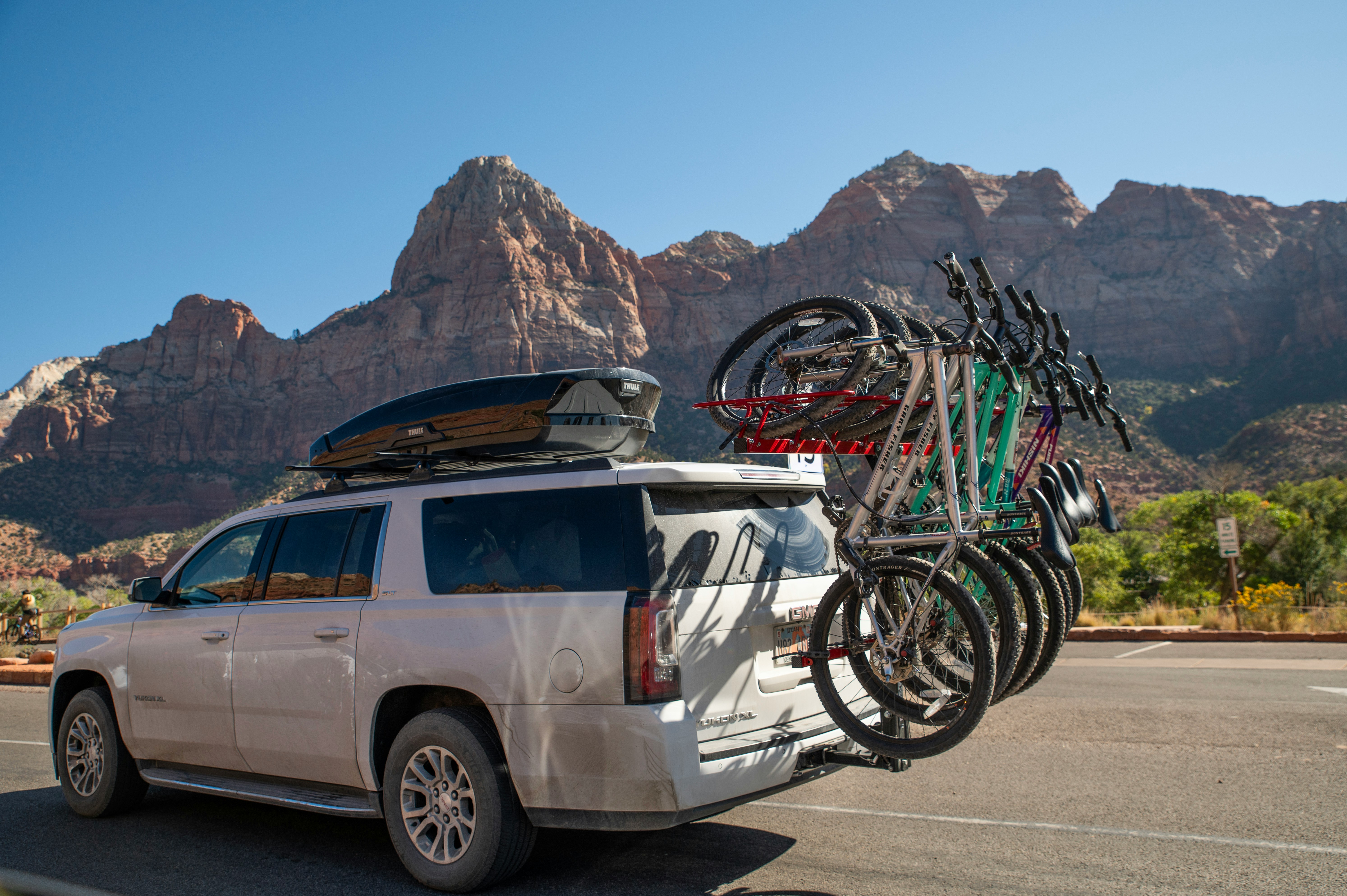
Most of us don’t have a roof rack: highway video surveys found empty crossbars on only about 3 percent of vehicles on a typical weekday. But if you’re in that 3 percent, here is the big reveal in today’s article: putting stuff inside or behind your vehicle, rather than stacking it on top, makes a huge difference for efficiency!
Consumer Reports ran a 2019 Nissan Altima at 65 mph and found bare crossbars alone cost almost 11 percent, and 19 percent with the carrier mounted. Oak Ridge measured a loaded roof box at 25 percent on a Corolla and 10 percent on an Explorer, while the same 100 pounds on a hitch-mounted tray (attached behind the vehicle rather than on top) cost 1 percent on both. Only the cargo’s position in the airstream changed: a roof box meets clean, fast air head-on, while a tray in the trailer hitch rides in the wake the car has already stirred up.
Berkeley Lab puts the national bill for roof racks at about 100 million gallons of gasoline a year. And most of that isn’t burned by the family driving bikes to the lake on Saturday. Cars with empty racks cover four to eight times more miles than cars with loaded ones. The simple step of replacing a roof rack with a hitch rack or tray is a big win!
Saving the best for last: take five off the top
The largest lever most of us have for sustainable travel is our speedometer. The Department of Energy figures every 5 mph over 50 is roughly like paying an extra seven percent for a trip. Easing off your top speed is better than almost anything you could do to your car. On a 300-mile summer drive, backing off from 75 mph to 68 mph costs you about twenty-five minutes in travel time, but puts a tenth of your gas money back in your pocket.
How you reach your top speed matters too. Oak Ridge National Laboratory found that speeding, hard acceleration, and hard braking together cost 15 to 30 percent at highway speeds and 10 to 40 percent in stop-and-go traffic. Gentle acceleration and cruise control on open highways are easy ways to save.
Your one step this week
Choose your step this week. Slow down 5 mph on your regular highway run. Check the tires cold against the door sticker. Set the family straight on the AC policy: windows down and vent on fresh around town, windows up with the AC on recirculate once you’re at speed. Haul on a hitch tray instead of the roof. And if there’s a roof rack or box up there you won’t use in the next few weekends, take it down. Put it back when you actually need it.
None of these steps require you to buy anything or trade in your vehicle. This is the quiet stealth strategy of the Movement pathway: we can make choices with what we already have sitting in our driveway. To see how eco-driving connects to the rest of the pathway, pick up a copy of Sustainable Practices: Your Handbook for Effective Action or visit www.suspra.com. And watch for The Practitioner’s Almanac: A Year of Sustainable Practice this fall, which lays every step in the framework onto the calendar. Not just what to do, but when it does the most good.
References and Resources
Driving More Efficiently — U.S. Department of Energy and U.S. EPA (gas mileage decreases rapidly above 50 mph, and each 5 mph over 50 is like paying about $0.32 more per gallon, for a 7–14% benefit from slowing 5–10 mph; aggressive driving costs 15–30% at highway speeds and 10–40% in stop-and-go; rooftop cargo boxes cost 2–8% city, 6–17% highway, and 10–25% at 65–75 mph, versus 1–2% and 1–5% for rear-mount trays; remove containers when not in use)
Sensible Driving Saves More Gas Than Drivers Think — Oak Ridge National Laboratory (aggressive driving lowers gas mileage by about 10–40% in stop-and-go traffic and 15–30% at highway speeds)
Fuel Economy in Hot Weather — U.S. Department of Energy and U.S. EPA (AC can reduce a conventional vehicle’s fuel economy by more than 25% in very hot conditions, especially on short trips; roll windows down at lower speeds and use AC at highway speeds; air out the cabin before switching the AC on)
Reducing Mobile Air Conditioner (MAC) Power Consumption Using Active Cabin-Air-Recirculation in a Plug-In Hybrid Electric Vehicle — Li, Brewer, Pham & Jung, World Electric Vehicle Journal 9(4):51 (2018) (over the SC03 cycle the AC drew 34.5% of total vehicle power on fresh air versus 28.4% on recirculate; energy use fell from 24.7 to 21.4 kWh/100 km; recirculation cut in-cabin particle concentrations about 92% versus outside air)
Simultaneously Reducing CO2 and Particulate Exposures via Fractional Recirculation of Vehicle Cabin Air — Jung, Grady, Victoroff & Miller, Atmospheric Environment 160:77–88 (2017) (full recirculation cut cabin particles but let CO2 rise to about 3,000 ppm, with possible effects on cognitive function; recirculating 50–75% held CO2 lower while still reducing particles)
Keeping Your Vehicle in Shape — U.S. Department of Energy and U.S. EPA (proper tire inflation improves gas mileage by 0.6% on average and up to 3%; under-inflation costs about 0.2% per 1 psi; use the door-jamb sticker, not the maximum pressure on the sidewall)
Fuel Consumption Impacts of Auto Roof Racks — Chen & Meier, Energy Policy (2016), accepted manuscript via OSTI (aerodynamic drag accounts for roughly 75–80% of total resistance at 100 km/h; highway video surveys found empty cross racks on 3.0% of vehicles on weekdays versus loads on 0.5%)
How Rooftop Carriers Affect Fuel Economy — Consumer Reports (a 2019 Nissan Altima at 65 mph lost almost 11%, about 5 mpg, to bare crossbars alone, and 19%, or 9 mpg, with the carrier installed)
Roof Racks a Drag on Fuel Economy — Lawrence Berkeley National Laboratory (roof racks accounted for about 100 million gallons of gasoline in 2015; miles traveled with unloaded racks run four to eight times higher than with loaded racks)
Related One Step Articles
Holiday Travel Efficiency: The Pressure is On — Sustainable Practice, One Step This Week (the winter half of this cycle: how to check tire pressure properly and why cold weather quietly deflates it)
Smart Moves: Your Guide to Earth-Friendly Transportation — Sustainable Practice, One Step This Week (the whole Movement pathway in one piece, from trip planning to driving electric)
Pedal Power: Two Wheels, Three Wheels, Zero Emissions — Sustainable Practice, One Step This Week (the most efficient vehicle you own is the one that doesn’t burn anything)
Join Sustainable Practice
Expand your positive impact on Earth by becoming a sustainable practitioner today! www.sustainablepractice.life
Sustainable Practice empowers you to protect our planet in practical ways. Share this article with someone heading out on a summer road trip — one of these, or all five, steps could help them save a bundle!