Bag Trash Before It Breeds
A field study found that litter can encourage other bad actions. World Cleanup Day gives millions of people worldwide a single coordinated day to break the cycle of bad habits in their neighborhood
This week, grab gloves, a trash bag, and a friend or two, and go for a walk together to clear litter from your neighborhood. Dutch field experiments show why this is effective. Researchers left a stamped envelope sticking halfway out of a public mailbox with a five-euro note visible through its address window. The money looked like it had been left accidentally, tempting a person to take it. When the mailbox and the sidewalk around it were clean, just 13 percent of passersby pocketed it. But with litter on the ground nearby, the rate of pocketing almost doubled to 25 percent.
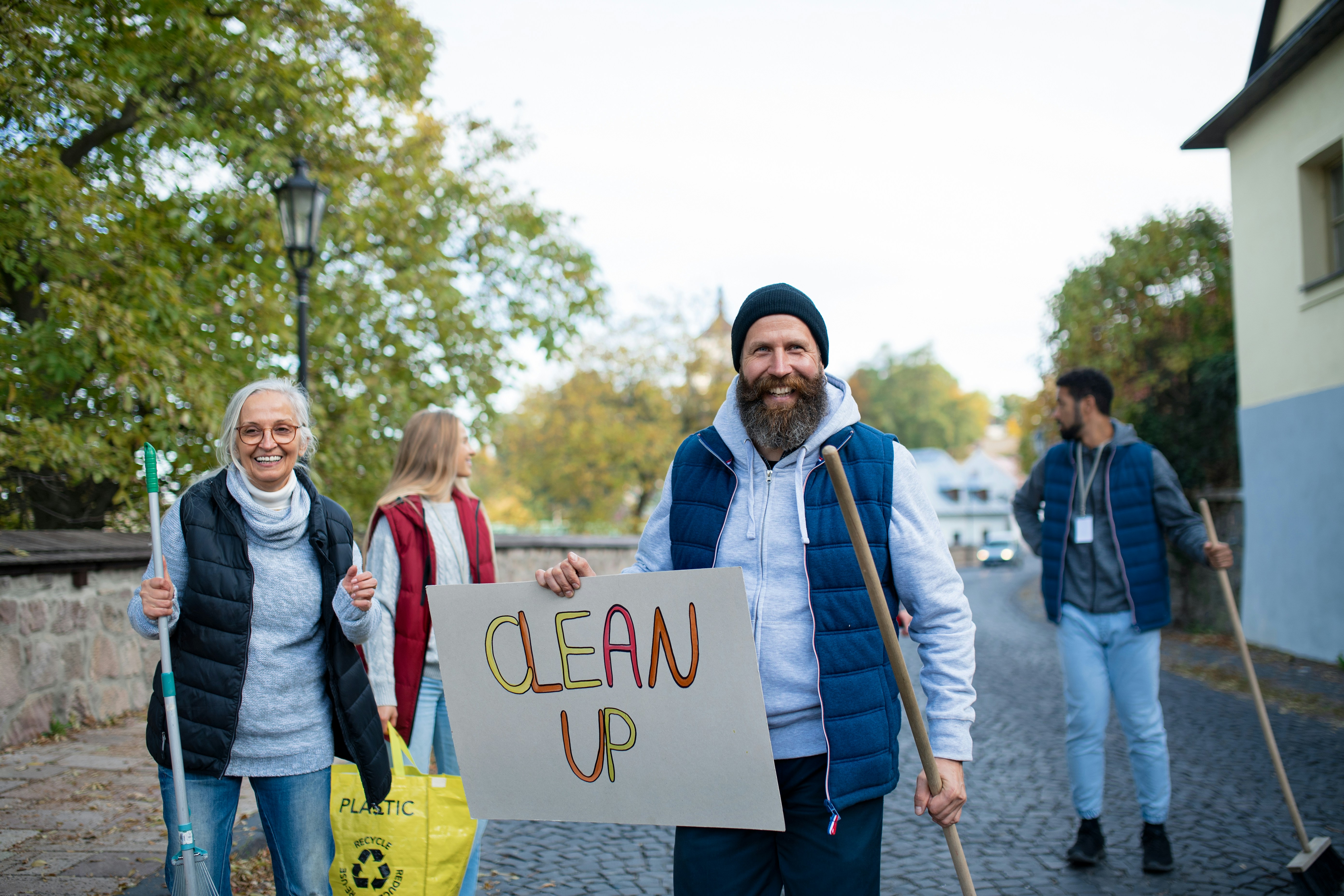
Five other versions of this test showed the pattern: one visible sign that somebody broke a rule and walked away from it (such as litter) makes the next person more willing to break a different rule. The researchers called it the spreading of disorder. That explains how a neighborhood cleanup does more than haul away trash. It removes the cue that invites more littering.
This is a step on the Community pathway, which includes sustainable practices designed to build networks of people who look after shared spaces together instead of leaving them for someone else to clean up or maintain.
Peggy’s Note: When Fred and I, your One Step writers, produced this year’s Earth Day Festival in Brunswick, Maine, in April, a big part of the day was a collaboration with Mere Point Oyster Company and Surfrider. We did a major area beach cleanup, and Surfrider carried collected trash and debris away from the beaches.
Let’s Do It World, the Estonia-based nonprofit that has coordinated World Cleanup Day every September since it went global in 2018, reported a record 25 million participants across 190 countries and territories in 2025. Between 2018 and 2024 alone, volunteers removed more than 708,000 tonnes of waste. The United Nations noticed this because, in December 2023, the General Assembly adopted a resolution proclaiming September 20 an official UN International Day, with UN-Habitat helping coordinate observances since the first UN-recognized edition in 2024. In the United States, National CleanUp Day runs a parallel effort the same weekend, with over 2 million volunteers in past years.
We now know that visible neglect signals something to other people. Clean up a spot, and you’re not only hauling away a small piece of trash. You’re leaving a signal for the next passerby that someone cares about this place.
Another reason to pick up litter as soon as you see it is that it doesn’t always stay put. NOAA’s Marine Debris Program estimates that roughly 80 percent of ocean trash starts on land, is carried off by wind, storm drains, and rivers rather than being dumped straight from a boat. Last September, Ocean Conservancy organized nearly half a million people worldwide to pull 7.4 million pounds of trash from beaches and waterways in a single day, including more than 1.2 million cigarette butts, whose cellulose acetate filters persist for years. Every piece of trash your neighborhood cleanup keeps out of a storm drain is one less piece with a shot at reaching a creek, then a river, then a coastline somewhere downstream. So this step, starting on the Community pathway, also reaches into the Water and Habitat pathways too.
Your one step this week
If you’re reading this on September 20, look for a registered cleanup near you at worldcleanupday.org, which maps events by country. Or check nationalcleanupday.org if you’re in the U.S. If nothing’s listed nearby, organize your own impromptu event: grab a couple of trash bags and some work gloves, invite one or two neighbors, and spend half an hour or half a day on a stretch of street, park edge, or waterway you’ve noticed that’s clearly nobody’s assigned job to keep clean. If you want the effort to feed research and policy, not just a tidier block, log what you collect with Ocean Conservancy’s free Clean Swell app. Your data will land in the same global database that has tracked cigarette butts as the single most common item picked up worldwide for many years running.
Do a cleanup once, and you’ve removed some trash. Do it as a habit on your own block a few times a year, rather than only on the one globally coordinated day, and you become the reason a place reads as cared for instead of abandoned—which, research suggests, matters more than any single bag you fill.
Sustainable Practices: Your Handbook for Effective Action and www.suspra.com are packed with small, visible acts of care that ripple outward along the Community and other pathways. Or check out our One Step archive at www.SustainablePractice.Life for more ideas on adopting ongoing practices that send positive signals to other sustainable practitioners in your community.
References and Resources
Accelerating Towards the Tipping Point—World Cleanup Day 2025’s Record-Breaking Numbers — Let’s Do It World (a record 25 million participants took part across 190 countries and territories in 2025)
World Cleanup Day 2025: A Global Symbol of Unity Across 190 Countries — Let’s Do It World (between 2018 and 2024, more than 114 million people in 211 countries and territories removed over 708,000 tonnes of waste)
World Cleanup Day — UN-Habitat (UN General Assembly resolution 78/122, adopted December 8, 2023, proclaims September 20 as World Cleanup Day; UN-Habitat facilitates observance)
The Spreading of Disorder — Keizer, Lindenberg & Steg, Science (2008) (theft of a visible five-euro note from a public mailbox rose from 13% when the area was clean to 25% with litter nearby and 27% with graffiti nearby)
World’s Largest Beach Cleanup Celebrates 40th Year in September — Ocean Conservancy (486,000+ volunteers collected 7.4 million pounds of trash in the 2024 International Coastal Cleanup, including over 1.2 million cigarette butts; nearly 19 million volunteers have removed over 400 million pounds of trash since 1986)
Marine Debris Datasheet — NOAA Marine Debris Program (about 80% of marine debris originates on land, reaching the ocean via storm drains, streams, and rivers)
World Cleanup Day — Let’s Do It World (interactive map to find or register a cleanup event by country)
National CleanUp Day — National CleanUp Day (U.S.-based parallel event held alongside World Cleanup Day; past years have drawn over 2 million volunteers)
Clean Swell — Ocean Conservancy (free app for logging collected litter into the global Ocean Trash Index database)
Related One Step Articles
Leave a Trace — Sustainable Practice, One Step This Week (more ways to turn up for a park or public space, including the litter-picking that park volunteers do most often)
From Leaf to Reef: Managing Nutrient Run-off From Your Yard — Sustainable Practice, One Step This Week (another look at how what happens on land travels downstream to water)
When You Wish Upon a Bin… — Sustainable Practice, One Step This Week (a closer look at the mismanaged-waste problem cleanups are responding to)
Join Sustainable Practice
Expand your positive impact on Earth by becoming a sustainable practitioner today! www.sustainablepractice.life
Sustainable Practice empowers you to protect our planet in practical ways. Share this article with a neighbor or two who might love being part of a global movement while making your part of the world a little cleaner!