Check the Promise of Compostable Plastic Before You Buy It
Bioplastics can turn back into soil—but only in a hot industrial composter. Check whether this service is available locally, which it rarely is.
A plastic cup made from corn could be a sustainable marvel, doing the work of petroleum without the petroleum. Reaching for compostable bioplastic shows a real concern for our planet, and that instinct should be celebrated. It just needs one bit of knowledge to actually do good. A bio-based plastic cup can only be fully composted if it is processed in a vessel hot enough, moist enough, and managed long enough to break it down. Unfortunately for most people on Earth, that process is rarely available locally.
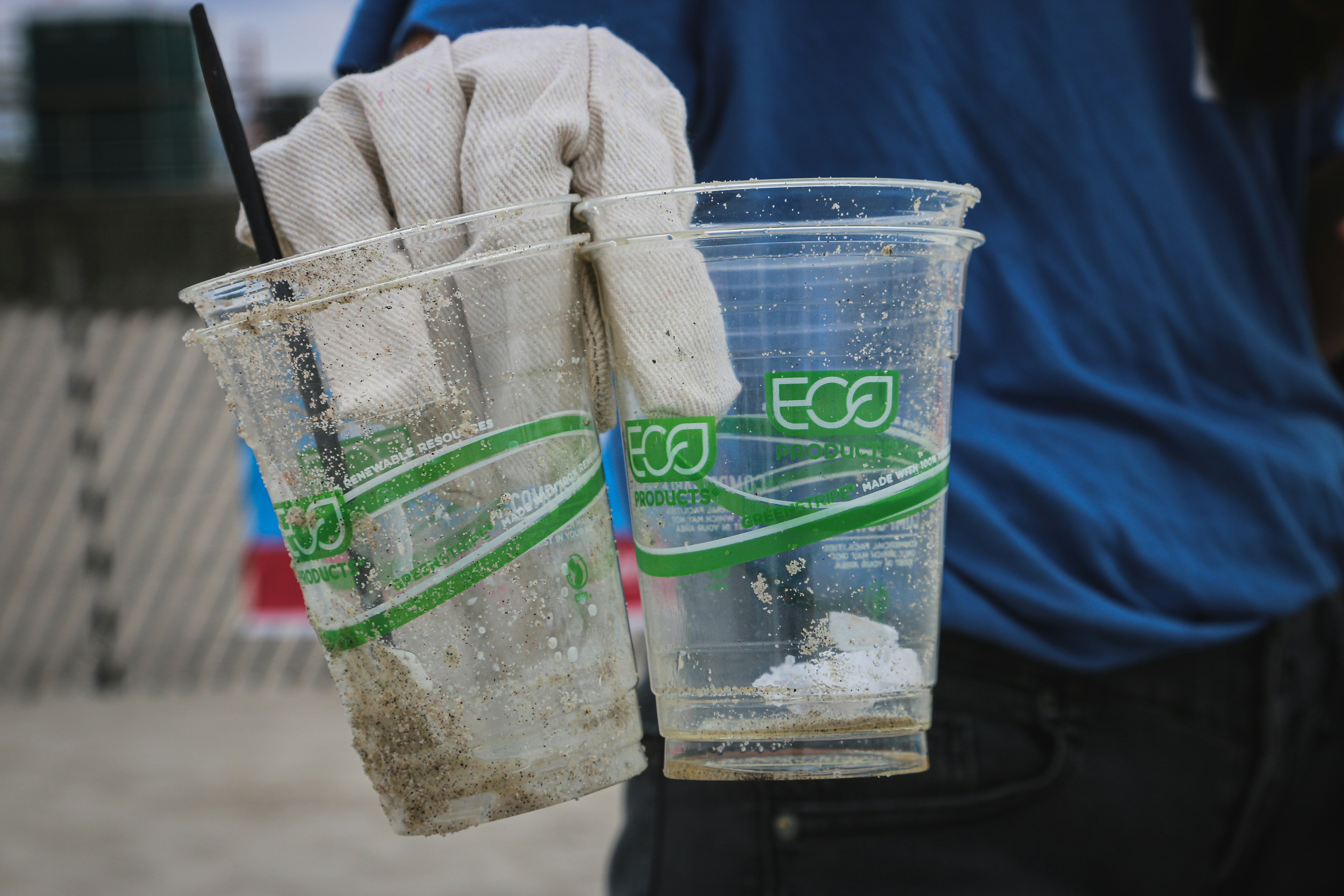
That gap isn’t your fault—it’s a fixable mismatch between a well-intentioned product and the complete system it needs to fulfill its promise. This Plastic-Free July, find out whether your community can handle compostable plastics. If it can, bio-based plastics are a wise choice. Otherwise, cross off all disposable plastics from your list of sustainable options and choose wood, paper, and other materials instead.
This is a step on the Goods pathway that covers how we consume, what our things are made of, and where they go when we’re done with them. Compostable plastics sit at the curve in the path materials take, rescuing them from incineration or landfill burial. Knowing your local composting reality helps you avoid an all-too-common mistake.
What bioplastics actually are
Bioplastics are derived from plants or bacteria rather than petroleum or fossil methane. The most common bio-based plastic precursor is polylactic acid (PLA). It starts as sugar from a grass such as corn or sugarcane, or a root such as cassava or beet, which is fermented into lactic acid and then linked into long polymer chains. This linking is the same trick used to make conventional plastic. Another common type of bioplastic is made from polyhydroxyalkanoates (PHA), produced by bacteria and starch blends.
The raw materials for bioplastics are living organisms that grow each season from air, water, and sunlight, rather than being manufactured from fossils pumped or dug out of the ground. In theory, the molecules in bioplastics can be returned to life through composting. This sustainable story is real, but comes with conditions, which is why good intentions alone are not sufficient to ensure the planetary benefits are not just imagined.
The composting and recycling reality of bioplastics
“Compostable” is a technical promise, not a wish. A standard called ASTM D6400 tests whether a material disintegrates and leaves no toxic residue within 180 days under active composting conditions: temperatures around 58°C (about 136°F), steady moisture, oxygen, and microbial activity, all held for weeks. The U.S. Environmental Protection Agency notes that most plastic products labeled compostable can only break down in a well-managed industrial composting facility, not in a landfill, a backyard bin, or out in the open. A home compost pile rarely climbs past 35°C, so a PLA cup will never fully break down in that environment. Instead, it tends to physically break down into microplastic contamination.
The system, not the shopper, is the problem. The United States has roughly 5,000 composting facilities, but most are designed for yard trimmings. Many that handle food waste run their cycles in 60 to 90 days—faster than some compostable plastics fully break down. As of 2025, only about 18 percent of the U.S. population lives where a collection program accepts compostable plastic. Compostable plastic that's sent to a facility that can’t handle it comes out the other end, contaminating the finished compost.
Recycling bioplastics is not an option, either. Drop a PLA cup in the recycling bin, and it becomes a contaminant there, too, since it is not compatible with polyethylene terephthalate (PET #1) or high-density polyethylene (HDPE #2), the two types of conventional plastic that have the best chance of being recycled (or at least downcycled). Specialized remote facilities do exist that accept bioplastics, but these require expensive shipping and handling. One option is Terracycle, which offers a 28-liter Biodegradable Plastic - Zero Waste Box for $181.
In most communities, “compostable” plastic gets burned in a trash incinerator or buried in a landfill where—starved of heat and oxygen—it persists just like ordinary plastic.
The microplastic catch
When a bioplastic trash item is blown out of a bin, dropped on a trail, or washed down a storm drain, it doesn’t vanish. It breaks into ever-smaller pieces. Microplastics, whether from conventional plastic or bioplastic, are fragments under five millimeters, and they’re now turning up nearly everywhere.
Being made from plants doesn’t make a plastic safe to leak into nature. In one marine study, researchers left PLA in flowing seawater. After 428 days, it showed no visible biodegradation, whereas natural cellulose fibers in the same tanks broke down in about 35 days. PLA degrades completely when subjected to moisture and heat of at least 58°C for months; the surface of the ocean never exceeds much more than 30°C. A compostable cup in the sea is just another source of microplastics.
Consider the full life-cycle of plastic
“Bio-based” doesn’t automatically mean lower-impact than fossil-based plastic. Comparative life-cycle assessments vary widely depending on feedstock and end-of-life assumptions. No bioplastic is a clear sustainability win—what it’s made from matters, and the end-of-life path you can actually give it matters, too. The land-use change of farming corn or sugar can shrink, or even erase, the sustainability advantage of bioplastic over fossil plastics; some cradle-to-grave studies have found corn-based bottles carry a heavier footprint than ordinary PET. Bioplastics made from agricultural waste rather than purpose-grown crops fare best in terms of planetary impact.
Furthermore, not all bioplastics are the same. The two main types are PHA and PLA, with PLA being more common. PHA is built naturally by bacteria as an energy store. Because living microbes recognize it, it biodegrades far more readily than PLA—not only in industrial composters but in soil, home piles, and even seawater, where reviews find it steadily breaks down while PLA persists for years. It also mineralizes more cleanly, leaving less of the fragment trail that turns stray PLA into microplastic. For anything likely to escape into nature, PHA is the better bet.
The catch is the front end: brewing and extracting PHA are more energy-intensive than PLA production. That makes it one of the costlier bioplastics and ties its pollution footprint tightly to the energy source used to make it.
What’s actually in the plastic
A plastic product is rarely one single material. Instead, it’s a base resin plus a cocktail of additives that give it flex, color, and durability—plasticizers like phthalates, heat stabilizers, flame retardants, pigments, and sometimes bisphenols or PFAS “forever chemicals.” A 2024 scientific inventory cataloged more than 16,000 chemicals associated with plastics: several are endocrine disruptors that can migrate into food, water, or us; at least a quarter are considered chemicals of concern; and roughly two-thirds have never been adequately studied for safety.
Bio-based doesn’t automatically mean additive-free, and “compostable” doesn’t guarantee “non-toxic”—the ASTM compost standard doesn’t even test for PFAS, though stricter certifications like BPI now require products to be free of intentionally added fluorinated chemicals. The takeaway is that fewer additives and trusted certifications are worth seeking out in any kind of plastic.
When plastic is unavoidable: a quick buyer’s guide
If you must choose plastic, you can choose wisely.
Reuse beats composting and recycling. A durable item that can be used many times is probably more sustainable than any single-use one, no matter what it’s made of.
Buy compostable only if you can actually compost it. Look for a BPI, OK Compost, or the European “seedling” certification, and only buy it when you can compost it. Otherwise, the reusable or the recyclable option will do more good.
When you buy fossil plastic, favor the few recyclable resins: #1 (PET) and #2 (HDPE), and #5 (PP). These have the highest chance of being recycled.
Skip #3 (PVC), #6 (polystyrene), and most #7 for anything touching food. These carry the toughest chemistry and the weakest end-of-life options.
Choose clear or light colors. Dark plastic is harder for sorters to see, so it more often slips through straight to the landfill.
Your one step this week
Find out if your community can compost bioplastic. Search your town or hauler’s name plus “composting” or “organics collection,” or check the U.S. Composting Council or BPI directories for a program near you that accepts certified compostable foodware or food packaging.
If so, those PLA cups and cutlery can deliver on their promise, so make that choice and tell a friend the good news. If no, skip the compostable single-use premium, lean on reusables, and when you do end up with a compostable plastic item, put it in the landfill bin rather than recycling.
Base your action on how the world really works rather than how a label hopes it does—which is the heart of being a sustainable practitioner. To go deeper on the Goods pathway and the science behind smarter materials choices, visit www.suspra.com, pick up Sustainable Practices: Your Handbook for Effective Action, or explore the related One Step articles below.
References and Resources
Frequently Asked Questions about Plastic Recycling and Composting — U.S. Environmental Protection Agency (compostable plastic must break down at a commercial/industrial facility hotter than a home bin; ASTM D6400/D6868 define the label; check your local program)
Focus on “Biobased,” “Biodegradable,” and “Compostable” Plastics — Washington State Department of Ecology (ASTM D6400 sets a 180-day breakdown standard; many facilities finish composting in 60–90 days and so screen out or reject compostable plastics; home composting is not tested)
SPC Data on U.S. Municipal Composting Programs — Sustainable Packaging Coalition / GreenBlue (about 18% of the U.S. population has access to a program accepting compostable packaging; roughly 36% to any composting collection)
Compost Infrastructure — Biodegradable Products Institute (nearly 5,000 U.S. composting facilities, the majority accepting only yard trimmings)
Not so biodegradable: Polylactic acid and cellulose/plastic blend textiles lack fast biodegradation in marine waters — PLOS One (PLA showed no visible biodegradation after 428 days in seawater; natural cellulose degraded in about 35 days)
Review of recent advances in the biodegradability of polyhydroxyalkanoate (PHA) bioplastics and their composites — Green Chemistry, Royal Society of Chemistry (PHAs biodegrade in soil and marine environments as well as compost, whereas PLA is only industrially compostable)
Poly(lactic acid) (PLA) and polyhydroxyalkanoates (PHAs), green alternatives to petroleum-based plastics: a review — RSC Advances (PHAs are compostable and marine-biodegradable, but energy-intensive extraction makes them among the most expensive bioplastics; PLA can persist in marine environments)
Life Cycle Assessment of Sustainable Materials: Methodological Asymmetries and Environmental Trade-Offs — Buildings, MDPI (for crop-feedstock plastics like PLA and PHA, indirect land-use change can dominate cradle-to-grave warming impact and sometimes negate the advantage over fossil polymers)
Life Cycle Assessment of PLA Products: A Systematic Literature Review — Sustainability, MDPI (review of 81 LCA studies; some cradle-to-grave analyses find corn-based PLA bottles higher-impact than PET due to the agricultural phase)
First Comprehensive Plastics Database Tallies 16,000 Chemicals — Scientific American, reporting the PlastChem 2024 report (16,000+ chemicals associated with plastics; ~25% chemicals of concern; ~two-thirds inadequately studied)
Plastic Chemicals — Collaborative on Health and the Environment (additive classes including phthalates, bisphenols, flame retardants, and PFAS, and their endocrine-disrupting health links)
Microplastics and Nanoplastics in Atheromas and Cardiovascular Events — New England Journal of Medicine (microplastics in artery plaque associated with higher risk of heart attack, stroke, and death)
Microplastics Research — U.S. Environmental Protection Agency (microplastics defined as fragments under 5 mm and their environmental prevalence)
Related One Step Articles
Plastic-Free July: Focus Your Efforts Where They Matter — Sustainable Practice, One Step This Week (where to aim your plastic-reduction energy for the biggest payoff)
World Oceans Day: Fighting Ocean Microplastics From Home — Sustainable Practice, One Step This Week (a deeper dive on where microplastics come from and how to cut them at the source)
When You Wish Upon a Bin… — Sustainable Practice, One Step This Week (why hopeful items like compostable plastics shouldn’t go in the recycling bin)
Join Sustainable Practice
Expand your positive impact on Earth by becoming a sustainable practitioner today! To learn more, visit www.sustainablepractice.life
Sustainable Practice empowers you to protect our planet in practical ways. Share this article with a friend who reaches for the compostable cup—so their good instinct lands somewhere it can do real good.