You Matter: How to Prioritize Your Sustainability Actions for Effectiveness
Use proven data within scientific frameworks to make a positive difference today
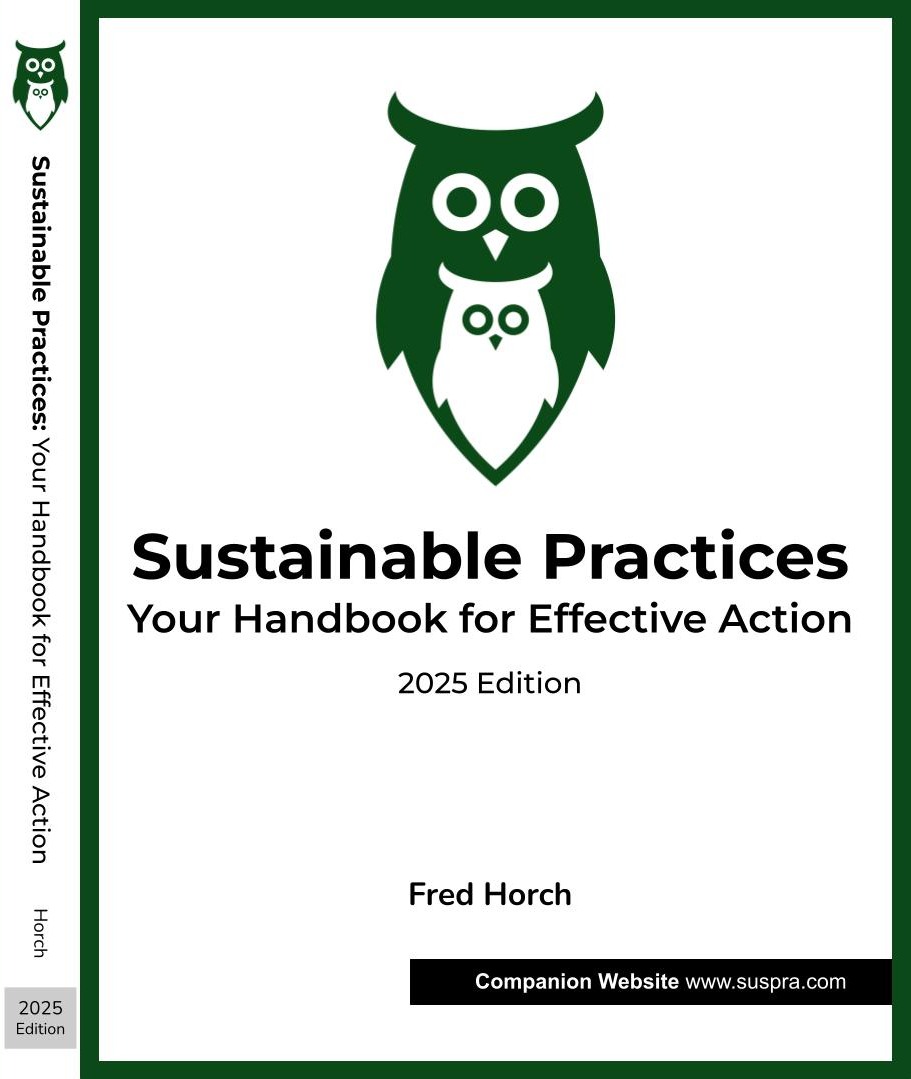
Note: Before we present today’s One Step This Week, we are announcing our April book launch of Sustainable Practices: Your Handbook for Effective Action. We expand the action steps shared in this newsletter over the past two years with details in one comprehensive handbook. It includes background information, scientific research, and methods to guide you in becoming superbly sustainable. In the coming weeks, watch for details about how to get your copy of the e-book or paperback version. Today, we are writing about how you can make wise decisions about continuing your sustainability journey. We want to assure you that, with the best information, you can make a difference as an individual committed to preserving Earth for future generations.
The Science of Collective Impact
Many people feel that individual actions are meaningless against massive global challenges. However, research demonstrates that the social contagion of sustainable behaviors is evident when our actions spread through social networks. There is individual impact shown through the ripple effect. Here's how the significance of individual actions and strategies inspire meaningful change:
Observable behaviors spread fastest: Rooftop solar installations show a "contagion effect" where each installation increases the probability of new adoptions within a 0.5-mile radius by 44% (Bollinger & Gillingham, 2012)
One-to-many influence: A single individual typically influences 4-7 others in their immediate network, with effects extending to "second-degree" connections (Christakis & Fowler research)
Neighborhood diffusion: Visible sustainability practices like composting, EV ownership or lawn alternatives spread through neighborhoods via "behavioral spillover" (Truelove et al., 2014)
Critical mass research shows tipping points are lower than we think:
The 25% rule: When 25% of a population adopts a new norm, it creates a tipping point for widespread adoption (Centola et al., 2018)
Early adopters drive change: The most crucial phase of any transition is early adoption by motivated individuals who demonstrate viability (Rogers' Diffusion of Innovations)
Recognition reinforces commitment:
Public recognition: Community recognition programs for sustainable actions increase participation by 35% and create social proof (McKenzie-Mohr, 2011)
Success stories: Narratives of successful collective impact, especially those featuring relatable people, are more motivating than statistics alone (Moser & Dilling, 2007)
Understanding the numbers can support your individual actions:
1% shifts matter: If just 1% of Americans adopted one plant-based food day weekly, it would save emissions equivalent to taking 1.3 million cars off the road (research by Wynes & Nicholas)
Aggregate impact: The collective carbon footprint of household consumption is 72% of global emissions (Ivanova et al., 2016)
Systems leverage: Individual actions create market signals that drive industry change—for example, the rise in plant-based foods was driven initially by consumer choices before institutional adoption
Individual actions strengthen civic engagement:
Behavior-attitude consistency: People who take environmental actions become more vigorous advocates for policy change (Thøgersen, 2012)
Policy support: Individuals engaged in sustainable practices show 37% higher support for related environmental policies (Lauren et al., 2016)
Civic spillover: Environmental behaviors correlate with increased civic participation, voting, and advocacy (Willis & Schor, 2012)
Powerful Anecdotes: When Individual Actions Created Meaningful Change
Here are compelling stories that demonstrate how individual sustainability choices have sparked a broader impact and resulted in significant changes:
The "Meatless Monday" Phenomenon
What began as a public health campaign with individuals choosing to skip meat one day a week has transformed into a global movement. Started by marketing professional Sid Lerner with the Johns Hopkins Bloomberg School of Public Health in 2003, this individual-level commitment:
Spread to over 40 countries
Was adopted by major school districts, including Los Angeles Unified, Baltimore City Schools, and New York City Schools
Influenced corporate cafeterias at Google, Toyota, and hospitals
Led to a measurable 20% reduction in meat consumption among participants
Contributed to the mainstreaming of plant-based alternatives, now a multi-billion dollar industry
The key lesson: Meatless Monday choices created market signals that transformed food systems.
Plastic Bag Bans: From One Concerned Citizen to National Policy
Rebecca Hosking in Modbury, England, came up with the idea of banning plastic bags in 2007 while in a pub one evening after filming a BBC documentary about the devastating effects of plastic bags on marine life. She was disturbed by a documentary about plastic. Instead of feeling helpless, she:
Convinced all 43 shop owners in her small town to stop using plastic bags
Made Modbury the first plastic-bag-free town in Europe
Inspired similar bans in over 100 UK communities within two years
Helped create momentum that led to national plastic bag charges across the UK, reducing usage by 98% in major supermarkets
This demonstrates how one person's determined action created a cascade of policy changes.
Rooftop Solar's Neighbor Effect
Australian university researchers have tracked what happens when a neighbor installs solar panels:
The neighbor effect leads to 15-20 solar installations per postcode per year on average
About 18% of new solar installs come from the neighborhood effect
Today, scattered individual installations have transformed into over 4 million home solar systems in the US, changing utility business models and accelerating renewable transitions.
The Refillable Revolution: From Kitchen Table to Inspiring Families Worldwide
In 2006, Bea Johnson began documenting her family's journey toward zero waste on a simple blog. Her individual commitment to refusing single-use packaging:
Inspired millions through her book and social media to adopt zero-waste practices
Today, what began as one family's experiment has become a mainstream retail concept.
The Student Who Changed School Food Systems
In 2012, then 9-year-old Martha Payne started a blog rating her school lunches in Scotland. Her individual documentation:
Attracted millions of viewers and media attention
Prompted immediate improvements in her school district's food
Raised over $146,000 for school meals in Malawi
Led to national policy changes in Scottish school nutrition guidelines
Inspired similar student activism across multiple countries
Her story shows how even a child's individual commitment to transparency can create institutional change.
The Community Compost Revolution
In 2011, David Buckel started a community composting program in New York City as a volunteer. The seemingly small act of collecting food scraps led this one leader to:
Develop composting sites as a nationally renowned pioneer in community composting
Coordinate up to 2,000 volunteers a year who helped process 150 tons of compostable materials by hand
Create a model replicated by other leaders who carried on his vision
Become the compost site coordinator for the NYC Compost Project
Change waste policy conversations in urban planning
This demonstrates how tangible individual local actions can scale to citywide impact.
These stories share a crucial insight: significant change can build through the accumulation of individual choices that demonstrate possibilities, shift markets, and create political will for broader transformation. Each person who acts creates evidence that another way is possible.
Priority-setting for Sustainability Actions
Sometimes, deciding how to order your best intentions in the areas of sustainability can be overwhelming. What will make the most significant impact when I have limited time or resources? Does what I do as an individual matter in the total scheme? Here’s a guide for taking the first steps, or more steps, along the seven pathways to sustainability based on scientific data. In One Step This Week, we have covered those pathways these past two years: Community, Food, Water, Movement, Energy, Goods, and Habitat. You can prioritize your next steps no matter where you are along the paths or where you believe our world is headed in meeting environmental challenges.
For Individuals:
Start by assessing your carbon footprint. If you can understand your most significant impact areas, typically transportation, home energy, food, and goods consumption, you can choose an area on which to focus. Each individual’s or family’s situation varies, but looking at activities in the four categories will guide you through the areas with the highest energy consumption to decide your actions. Sustainable Practice will offer a web app accompanying our book from which you can measure these patterns.
Focus on the high-impact changes first. Those practices with the most significant environmental benefit relative to the effort expended can guide you in prioritizing.
Consider habit formation. You'll have more success if you can gradually build sustainable habits rather than attempting radical lifestyle overhauls.
Prioritize social influence. Community-based approaches that leverage social networks will motivate you, your friends, your family, and your community.
For Organizations:
Identify which environmental impacts are most significant to your operations.
Using science-based targets, align reduction goals with scientific consensus on planetary boundaries.
Involve employees, customers, members, and communities in sustainability planning.
Address root causes rather than symptoms of unsustainability.
Scientific Frameworks for Decision-making or Prioritization
The Planetary Boundaries Framework proposed by Rockstrom et al. identified nine critical Earth system processes with quantifiable boundaries that shouldn’t be crossed. These can help us prioritize. For example, the climate change boundary, as outlined by the Stockholm Resilience Center, defines the ratio of incoming and outgoing energy of the Earth caused by greenhouse gases and aerosols as a boundary currently transgressed.
The Life Cycle Assessment (LCA) quantifies environmental impacts across a commercial product’s life cycle to identify resource use, human health, and ecological consequences of acquiring raw materials through production, use, and disposal.
Raworth combined social foundations with ecological ceilings in Doughnut Economics to define a “safe and just space” for humanity. An example is adding measures such as jobs, education, food, access to water, health services, and energy to help accommodate an environmentally safe space.
The Science-based Targets Initiative, a corporate climate action organization, provides methodologies for setting emissions reduction targets aligned with climate science.
The Circular Economy Framework prioritizes creating a closed-loop system where materials are continuously circulated and repurposed, maximizing resource efficiency through reusing, repairing, and recycling.
If we consider these guideposts for both individuals and organizations, what is best to prioritize so that we can help create lasting habits related to sustainability? Habits are hard to break and also hard to establish. In environmental and climate crises, we know that human habits have driven us to the point of grave problems, and reversing those habits will be the key to finding solutions.
Habit Formation Science
Work by Wendy Wood and others reveals that:
New habits typically take 66 days to form. We need to be patient with ourselves.
Context stability is crucial (same time/day). We need to be consistent.
Consistency matters more than perfection. Trying sustainable practices daily is more important than perfect success.
“Implementation intentions” (When X occurs, I will do Y) increase success rates by 91%. This is key to our establishing a habit.
Success, with what we know is a priority for advancing sustainability, is worth the work of establishing a habit that will endure.
Applied Examples with Research Evidence
Reducing Food Waste
Interventions combining information, skill-building (meal planning), and visual cues reduce household food waste by 27-39% (van der Werf et al., 2019)
Social comparison messages reduce restaurant plate waste by 30% (Kallbekken & Sælen, 2013)
Sustainable Transportation
Free public transit trials combined with implementation planning increase long-term ridership by 22-32% (Fujii & Kitamura, 2003)
Bike-to-work initiatives with social components show 40% higher continuation rates than individual-focused programs (Cairns et al., 2010)
Energy Conservation
Real-time feedback devices reduce household energy consumption by 5-15% (Karlin et al., 2015)
Community-based approaches combining education, goal-setting, feedback, and social interaction achieve 20% greater reductions than information-only approaches (Abrahamse et al., 2005)
As we consider whether our individual actions make a difference, we can view data that assures us that what we commit to can have wide-ranging effects on the community, the environment, the climate, and the policies being determined to meet today’s climate and environmental challenges. Stay with us on our Sustainable Practices journey for the continuing trip down pathways that will make a difference–in your life and the lives of others sharing the planet with us.