Powering Through Outages: Home Battery Solutions for Every Budget
Batteries are a critical step for the transition to clean energy
When your neighborhood goes dark during a power failure, imagine your home with lights still on, your refrigerator humming, and your phones charging. No noisy generator, no scramble for flashlights—just seamless electricity that keeps your life running smoothly. This isn't just for hospitals and emergency command centers anymore: solutions from portable power stations to whole-home backup batteries are making energy independence possible for everyone. Before spring storm season, now is the time to shield your family from outages, add resilience to your home, and even earn money while supporting a cleaner and more reliable electric grid.
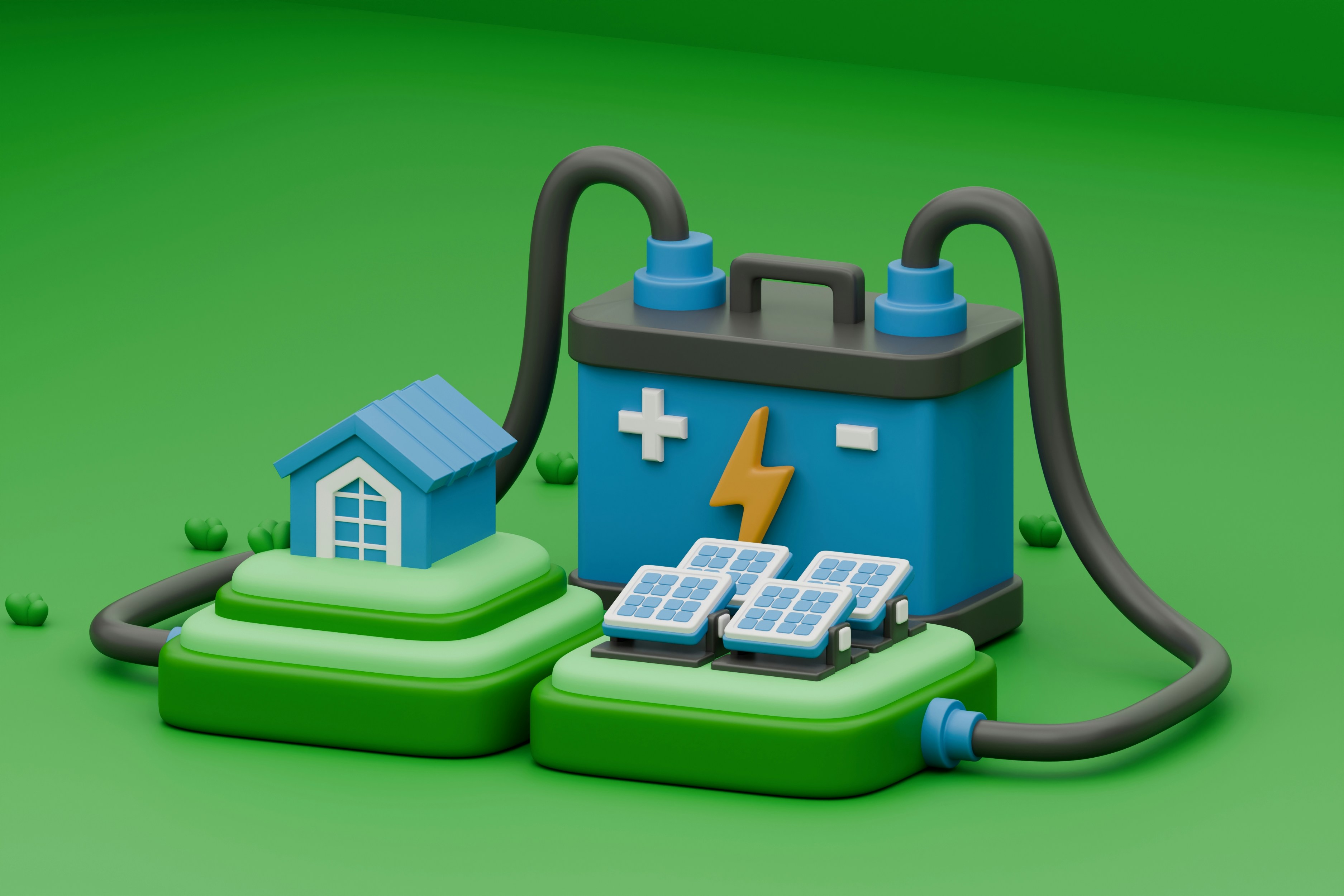
What Is a Battery Energy Storage System?
A battery energy storage system (BESS) stores electricity, charging when you have extra electricity available so you can use it later when you need it most. Adding electronic intelligence to battery cells, these systems are more reliable and capable than a simple battery. BESS comes in three main types:
Power Banks are handheld devices, often with a built-in solar cell, for charging cell phones, headlamps, and other small devices. Inside the power bank are rechargeable battery cells. Most power banks now use the universal serial bus (USB) standard for connecting devices and transferring electricity. USB is convenient because you can seamlessly swap between any USB wall charger or a power bank to charge any USB device. The days of incompatible charging cords and packs of disposable batteries are becoming history.
Portable Power Stations are compact, movable units that can power small devices and appliances. They usually include an inverter, allowing you to use a USB or a three-prong plug to use the stored electricity. Think of them as super-sized power banks that can run everything from phones and laptops to refrigerators and medical devices.
Partial-Home or Whole-Home Battery Systems permanently connect to your home's electrical panel. These larger systems can power circuits or even your entire home from their batteries.
Why Batteries Benefit Everyone
Whether you have solar power or not on your property, batteries benefit you:
Emergency Preparedness: Keep essential systems running during power outages without noisy, polluting generators that require fuel and diligent maintenance
Financial Savings: If your utility has time-of-use rates, charge your battery when electricity is cheap and use stored power during expensive peak periods
Grid Support: Participate in utility demand-response programs that pay you to help stabilize the electric grid for your neighborhood
Environmental Benefits: Enable more solar power in your community by helping balance supply and demand
Many electric utilities and state agencies, including Efficiency Maine, have programs to pay people for allowing their whole-home battery systems to be used to stabilize the public power grid. During periods of sudden peak power demand surges, such as when a storm knocks a power plant offline, within milliseconds, batteries can discharge power to prevent system overloads and keep electricity flowing smoothly to everyone. The more battery storage people install, the more reliable and resilient our whole power grid becomes.
The ability to buffer power flow is essential to enable more solar power for the grid because clouds and other weather conditions cause the power output of solar farms to fluctuate. Batteries smooth out these power curves, allowing solar to replace coal and gas power plants. Furthermore, as we use sunlight to generate more electricity, we get a glut at noon. Batteries can store this excess for a few hours, so it’s available all afternoon and evening.
Quick-Start Battery Storage
Whenever you have a chance to upgrade a hand-held electronic device, look for one that charges using the USB standard. It’s time to phase out all disposable AAA, AA, C, and D batteries from our homes and use longer-lasting devices with built-in rechargeable batteries. If you buy two power banks, you can charge one using a small solar module while using the other to charge your phone and other devices. With a couple of power banks and small solar modules–all compatible with USB cords and plugs–you’ll not only have a solution for daily use but also a basic emergency power kit that’s completely portable.
Intermediate Battery Storage
Portable power stations are the next step up from power banks. They can do everything a power bank can do, using the same USB standard and accepting a charge from a compatible solar module, but more powerfully and for longer. If you’re not familiar with how electricity works, you’ll want to review the refresher below before purchasing a power station so you understand its ratings and capabilities. Power stations range in size from a small toaster to a large suitcase. Larger ones have wheels, making them technically portable, but not really very practical to take with you or up and down stairs.
A portable power station offers an affordable way to use sunlight to make your electricity. With a little planning, you can build a rack and attach one or two solar modules to create a solar electricity generator, which you can position on a porch, deck, or lawn facing the sun. Then, connect it to charge your portable power station. Many manufacturers of portable power stations offer compatible racks, solar modules, and cords. Just be careful to follow instructions carefully when connecting and disconnecting the wires between your batteries and your solar modules.
A quick way to go solar without needing to hire an electrician, because you’re not connecting anything to your home’s electrical wiring, is to charge a portable power station with sunlight and use it daily to power your computer, television, and a few other loads. Rather than plugging your devices into a wall outlet, plug them into your power station. Then charge up your power station with solar. This way, you can go “off-grid” little by little—every load you take off the grid means less need to keep operating power plants that burn fossil fuel. If you’re worried about the energy impact of AI and are in the market for a new computer, upgrade to one of the new super-efficient AI PCs so you can download AI models and run them locally using solar power. A five-year-old computer consumes eight times as much electricity as a new one—and the energy efficiency of computers is expected to grow even faster in the next five years.
Check out the list below to see which devices are low power, easy to run from a portable power station, and which are high power, requiring the next level of battery investment. During a power outage, one of the most practical uses of a portable power station is to keep a refrigerator or freezer running.
Advanced Battery Storage
If you’ve been thinking about a generator or have an old gas-powered generator that you trot out during emergencies, batteries with solar modules are now a better option unless you live in a place without sunlight. By adding a disconnect switch and a critical loads subpanel, you can safely switch over from grid power to battery power whenever you want. Unlike a fuel-burning generator, batteries can be located inside and produce little to no noise when operating. Some battery systems use small fans to keep their components cool; others allow warm air to rise and flow out naturally.
Recommended steps:
Consult with an electrician to design a critical loads subpanel—since you’ll be connecting to your home’s electrical wiring, you’ll need an electrician or training because your home’s electrical system can deliver lethal amounts of current
Purchase a battery energy storage system with sufficient capacity
Have your electrician install the transfer switch, subpanel, and battery system
Install a solar array outdoors, either on the ground, on an awning, or on your roof
Connect the solar array to keep your battery charged
Expert Battery Storage
An expert can help you install a whole-home battery system, enabling you to achieve energy independence and support the public power grid if you choose.
Recommended steps:
Hire a professional electrical contractor who specializes in battery systems
Upgrade electrical panels and transfer equipment as needed
Install a battery system with sufficient capacity to power your whole home
Integrate with your home automation systems
Install a solar array outdoors, either on the ground, on an awning, or on your roof
Connect the solar array to the public power grid, and your battery
How Much Power?
Understanding power requirements helps you size the battery for your needs. Note: these are rough estimates. Check an appliance’s electrical plate to get the exact power rating.
Cell Phone Charging: 5 to 15W / 0.05 kWh per day
LED Light Bulb: 10W / 0.1 kWh per day
Wi-Fi Router: 15 to 20W / 0.4 kWh per day
Laptop Computer: 50 to 100W / 0.5 kWh per day
Television (LED, 43"): 60 to 100W / 0.3 kWh per day
CPAP Machine: 30 to 60W / 0.5 kWh per day
Home Security System: 50 to 100W / 1.2 kWh per day
Refrigerator (Energy Star): 100 to 200W / 1 to 2 kWh per day
Sump Pump: 300 to 800 W / 0.8 kWh per cycle
Washing Machine: 500 to 800 W / 0.5 kWh per load (not including hot water)
Coffee Maker: 800 to 1,400 W / 0.1 kWh per brew
Microwave Oven: 1,000 to 1,500 W / 0.2 kWh per meal
Well Pump: 750 to 1,500 W / 1 to 2 kWh per day
Electric Space Heater: 1,500 W / 1.5 kWh per hour
Hair dryer: 1,800 W / 0.3 kWh per ten minutes
Electric Clothes Dryer: 3,000 W / 3 kWh per load
Electric Water Heater: 4,500 W / 12 kWh per day (depending on water use)
Technical Box: Understanding Battery Specifications
When evaluating battery systems, you'll encounter several technical terms, like volts and amp-hours. Here’s a quick overview so you can understand your options. As the world turns to electric everything, this knowledge is becoming more and more useful.
Voltage and Amperage
Volts (V): Electrical force in the system
Amps (A): Rate of electrical current flow
Amp-hour (Ah): Amount of current flow (seen on older battery types)
Power: Watts = Volts × Amps
Energy: Watt-hours = Volts × Amp-hours
Household context: Standard US outlets provide 120 V of electrical force at 15 to 20 A of current flow, which provides 1,800 to 2,400 watts of power
Power vs. Energy: kW vs. kWh
Kilo: means one thousand, so 1,000 watts = 1 kilowatt
Watt (W) or Kilowatt (kW): Measures power—how much electricity can flow at once (like gallons per minute for water)
Watt-hour (Wh) or Kilowatt-hour (kWh): Measures energy capacity—how much electricity can be stored (like gallons of storage capacity for water)
Household context: A 6,000 W / 9 kWh battery is powerful enough to run a 3,000 W clothes dryer for three hours or two 3 kW clothes dryers for 90 minutes, but a 2,000 W / 9 kWh battery is not powerful enough to run a 3 kW clothes dryer at all.
Battery Cycles
One cycle: A complete discharge and recharge of the battery
Cycle life: Number of cycles before capacity drops to 80% of original
Household context: A battery rated for 4,000 cycles can be fully cycled daily and last for more than ten years.
C-Rating (Charge/Discharge Rate)
Definition: How quickly a battery can safely charge or discharge relative to its capacity; a higher C-rating means a battery can provide more power or charge more quickly
Household contact: A 48 V 100 Ah battery with a 0.5C discharge rate has an energy capacity of 4,800 Wh and can safely provide 2,400 W of power; a 48 V 200 Ah battery with the same 0.5C discharge rate can safely provide 4,800 W of power
Battery Storage vs. Traditional Generators
Here’s why home batteries are starting to nudge out fuel-burning generators for backup power.
Instantaneous, automatic startup
Silent or very quiet operation
No fuel required
Zero direct emissions
Safe for indoor installation and operation
Minimal maintenance checks, no oil changes
Years of runtime when recharged with solar
Resources and Further Reading
The 5 Best Portable Power Stations of 2025, Popular Mechanics
Home Battery Backup Systems: A Guide to Emerging Power Storage Solutions, This Old House
How Do You Connect Solar Panels to a Portable Power Station?, EcoFlow Blog
Small Battery Management, Efficiency Maine
Household battery storage still best fix for solar duck curve problem, Renew Economy
Taking Your Next Step
You have the power to create a more resilient, sustainable future. Every home with battery storage is a beacon of energy independence and environmental stewardship. When the grid falters, you'll stand strong—silently powering on without pollution. With each passing year, these systems become more affordable and powerful. Today's small step—whether researching or installing your first system—ripples outward, inspiring neighbors and strengthening communities. By choosing battery storage instead of a fuel-burning generator, you're not just preparing for emergencies; you're actively participating in the clean energy revolution that our world desperately needs.