You've Got the Power: A Guide to Generating Solar Electricity Today
You can now buy solar modules for less than $0.30 per watt, have complete systems installed for less than $3 per watt, and get a 30% tax credit in the United States.
How fast we’ve ramped up solar electricity since 2014 has surprised experts: next year, the United States will generate more electricity from sunlight than from hydropower! My guess is we haven’t seen anything yet. People now realize that electricity can affordably meet all their energy needs, even heating and transportation. Enough sunlight lands on single-family homes to power everything in and around them—not just lighting and appliances, but heating air and water, cooling and dehumidifying, and charging electric vehicles. As solar farms proliferate, everyone in North America uses more solar electricity without realizing it. If you’re worried about missing out, install solar on real estate you own and start generating valuable electricity from sunlight before it’s all gone. (Just kidding—we’ll never run out of sunshine!)
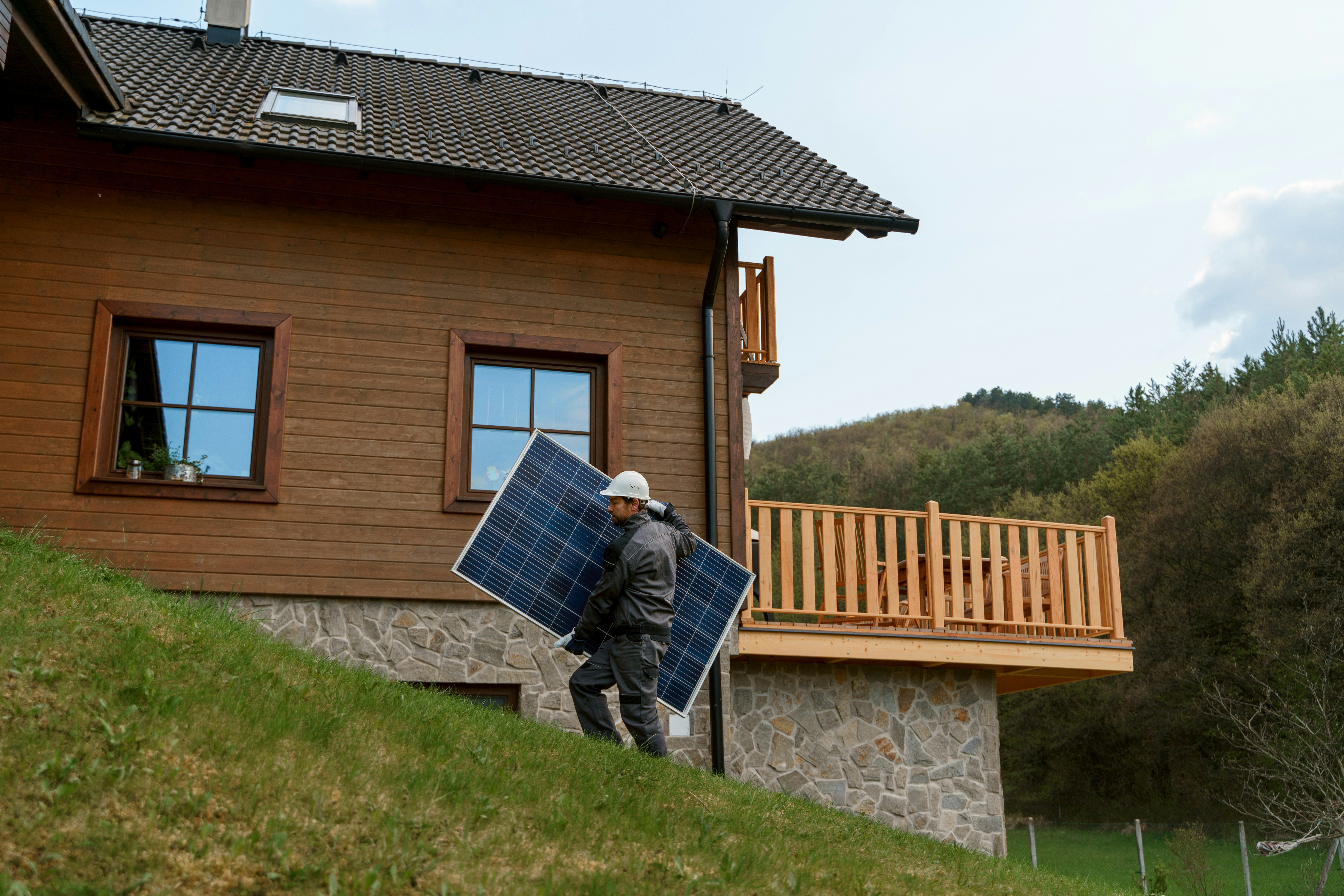
Two That Matter Most
To know how well you are meeting your need for energy without waste or unnecessary pollution, these two indicators matter most:
What percent of your energy use is electricity?
What percent of your electricity is generated by sunshine?
Powering 301
Generating Solar Electricity
Generate electricity from sunlight.
Equipment and Materials
Solar photovoltaic modules
Racking and wiring
Charge controller [optional]
Storage battery [optional]
Inverter [recommended]
Steps
Determine where on your property a solar array could be installed.
Determine if you can install a solar array yourself or need to hire an electrician.
Decide which loads you’d like to power with solar electricity.
Decide whether you want battery backup for power outages.
Get multiple quotes, compare them, and then choose your installer (or do the work yourself).
If your array will be inter-connected with the local power grid, get permission and sign the necessary agreements with your electric utility.
Hire an installer, or order the equipment and install it yourself.
Have your system inspected by your local code officer (if necessary).
Discussion
Light can easily be converted to electricity using photovoltaic (PV) cells, which can be combined into modules and then grouped into arrays. Solar PV arrays:
Generate electricity without producing any noise or pollution.
Operate anywhere that receives sunlight, all over Earth and beyond.
Can be independent of the public power grid or interconnected with it.
Can generate some, all, or more power than a home uses.
If you are soliciting bids to install solar, compare proposals by cost per watt and capacity factor. In the United States, the installed cost of a residential-scale array (below 20,000 watts) is now between $2 and $3 per watt, and the capacity factor is between 12% and 16%. Calculate cost per watt by taking the cash cost of the project (before tax credits or any other incentives) and dividing it by the DC power rating of the array in watts. One kW equals 1,000 watts. Calculate the capacity factor with this formula:
Estimated annual electricity production in kWh, divided by
DC power rating of the array in kW times 8,766 hours
If you have any difficulty calculating $/W or capacity factor for a solar proposal, reach out to a sustainability practitioner for help. Use PVWatts to estimate annual electricity production for any solar array.
Placing modules in full sun is the most important consideration for solar electricity. A solar module is a plastic housing or metal frame containing glass over dozens of PV cells connected to a positive and negative wire to conduct electricity. As of 2024, a typical module has a warranty of 25 years, an expected useful life of at least 30 years, and an efficiency rating between 20% and 25%, meaning with 1,000 watts of incoming sunlight, it produces between 200 and 250 watts of direct current electricity.
Capacity factor is how much electricity is actually produced compared to how much could be produced if the module were always in full sun. This factor mostly depends on how much sunlight the module gets but also depends on the efficiency of other system components. The higher the capacity factor, the better.
The same module in different locations will probably have different capacity factors, because different locations probably get different amounts of sunshine. While capacity factors vary, they are also very predictable within a range. Everywhere on Earth, we know exactly when the sun will rise and set and where it will be in the sky. Insolation (incoming power from the sun) per square foot in most places in the United States varies between zero (at night) and 100 watts (at solar noon on a clear day).
You can connect electric equipment directly to a solar array (as long as you match voltages), but this has limited use because electricity only flows from a module when the sun shines. Still, for intermittent loads like irrigation pumps or attic fans, direct connection with no battery is simple, cheap, and efficient. Storing electricity in a battery makes solar power more expensive but much more practical.
If you have a sunny driveway or yard, you can build a solar carport, solar garden shed, solar greenhouse, or solar pavilion and mount larger solar modules there. This usually can generate more electricity per square foot than adding modules to an existing roof because the modules can be packed tightly together and oriented to collect the maximum amount of sunlight. You can also attach solar modules to poles or frames on the ground. With ground mounts, you’ll give up some use of land but save a little money compared to building a pavilion.
If you are designing a new building, you can plan the roof for solar to minimize array cost and maximize electricity production. If you have an existing building, you can usually find some sunny roof areas where you can add solar modules, but you’ll usually not be able to achieve the same capacity factor you can if you build a solar carport, solar garden shed, solar greenhouse, solar pavilion, or ground-mounted array in full sun.
Under or near your solar array, you can install a charge controller and a 12 to 48-volt storage battery. Connect your battery and then your array to your charge controller. Then, you can connect loads, such as DC LED lights, DC fans, small DC appliances, and battery chargers, to your charge controller. The charge controller ensures that power flows from the solar array to the batteries and loads safely; if you use a 48-volt storage battery, use a 48-volt charge controller. DC-to-DC converters allow you to power any safe low-voltage (48 V or below) load. Equipment with standard connectors like USB-C and power over Ethernet have DC-to-DC voltage conversion built in.
One 400-watt solar module will generate 400 watt-hours of electricity in one hour in full sun. Batteries for lawn equipment, power tools, and laptops store a few dozen watt-hours.
You can continue to scale up the size of a solar array by using more modules. Once you start covering hundreds of square feet, power and energy units increase by 1,000 from watt to kilowatts (kW) and kilowatt-hours (kWh).
A 240-square-foot 4.8 kW solar carport in North America will produce between 5,000 and 6,000 kilowatt-hours (kWh) of electricity per year, which is more than an average EV consumes. (Cars are driven around 14,000 miles per year, and EVs get between 3 and 4 miles per kWh.) You can connect a charge controller, storage battery, and an EV charger to your array. Then, you can park under your carport, plug in, and charge any electric vehicle from the storage battery at night or directly from sunlight during the day. Electric bike batteries store between 0.3 and 1 kWh; passenger car EV batteries store between 50 and 100 kWh, and up to 200 kWh for large pickup EV trucks.
Besides the capacity factor advantage, building a simple off-grid solar structure avoids asking your utility's permission to interconnect with the public power grid. It also eliminates the need to trench or string overhead wires. Your solar array, charge controller, and storage battery are a completely independent microgrid. If you’re handy, you might also save on installation, permitting, and inspection costs by doing an off-grid solar structure as a weekend DIY project.
You'll need to install an inverter for solar arrays that need to power an electrical panel serving alternating current circuits. In the United States, residential inverters convert DC electricity from solar PV cells to a 60-hertz 240-volt split-phase AC signal, providing both 240-volt and 120-volt power circuits.
Inverter-based systems:
Provide the same kind of electricity as the public power grid
Can be off-grid or inter-connected to the power grid
Can operate without batteries when grid-connected or have battery backup to enable them to operate during a power outage
Can be sized to provide less than or equal to the amount of electricity a home uses per year
It’s technically possible to install grid-connected solar arrays that provide more electricity than a home uses, exporting the excess to power the local neighborhood. However, utilities often have rules prohibiting this. In some jurisdictions, net metering rules make it hard for utilities to extract as much profit from owners of solar arrays as they would like to, so utilities limit the amount of solar power a homeowner can export to their neighbors.
If your solar array will be installed on or interconnected with a structure that is inhabited, you’ll probably need to pull a permit and have the work inspected when completed. A growing list of rules are intended to protect life and safety.
Definitions
Alternating Current: electric current that changes direction because voltage alternates between positive and negative
Array: a group of modules that are connected together
Direct Current: electric current that flows in one direction because voltage remains steady
Capacity Factor: the ratio of electricity actually produced divided by the electricity that could be produced under ideal conditions
Charge Controller: electrical equipment that can control the flow of electricity, ensuring that a solar array can safely charge batteries and power electric equipment
Electricity: the flow of charge due to voltage
Grid Connected (Inter-connected): a solar array that is connected to an inverter that is connected to the public power grid
Insolation: the amount of energy reaching the Earth from the sun
Inverter: electrical equipment that converts direct current to alternating current by varying voltage from positive to negative
Kilowatt: one thousand watts; one thousand joules of energy per second
Kilowatt-hour: the energy of one kilowatt of power for one hour
Module: a piece of equipment that contains photovoltaic cells and has a positive and negative wire to conduct current; a module can be used on its own or be part of an array
Net Metering: a billing practice that gives credit for solar electricity exported over a public power grid
Off Grid: a solar array that is not connected to the public power grid
Photovoltaic: converting light to electricity
Photovoltaic Cell: material that generates electricity from light; cells are typically connected in series (to boost voltage) inside a module
Split-Phase: an alternating circuit with a neutral wire providing a return path at a voltage between the positive and negative voltages
Voltage: positive or negative electromotive force that causes current to flow
Watt: one joule of energy per second
Watt-hour: the energy of one watt of power for one hour
Troubleshooting
You aren’t sure if you have enough sun to go solar.
Ask for an estimate from a local solar installer; they can easily check satellite maps online to make a quick determination.
You don’t want to put solar modules on your roof.
Install a ground mount array.
Install a solar awning on the side of a building.
Install a free-standing solar pavilion.
Install a solar carport.
Your solar array is not producing its rated output.
Check for dirt or shading.
Review the inverter logs (many modern inverters record output from every module in the array) to check for error messages.
Have a solar technician inspect your system.
Strategies and Goals
Energy
Solarize
Generate electricity from sunshine on-site
Habitat
Prevent Pollution
Protect environmental health and well-being
Community
Demonstrate Best Practices
Inspire people in your community to go solar
Milestones
Increase the share of electricity in your energy mix.
Measure: Ratio of electricity to total energy consumption
Method: Utility and fuel bills
Time Period: Year
Reduce pollution emitted from your energy use.
Measure: Pollution emissions
Method: Emissions calculator
Time Period: Year
Increase the number of people in your community going solar
Measure: Solar installations in your neighborhood
Method: Survey
Time Period: Year
Limitations
Not everyone owns real estate; landlords may not allow solar.
Some properties are heavily shaded.
Larger solar installations require capital.
Not everyone has good credit.
Grid-connected systems require utility permission and inspection.
Some jurisdictions require licensed electricians to be involved in solar installation.
Opportunities
Powering 101: Getting More Efficient
Powering 102: Reducing Peak Demand
Powering 201: Buying Solar Electricity
Powering 202: Solar Charging Batteries
Powering 302: Using Solar Water Heating
Powering 303: Using Solar Space Heating
Powering 401: Using Battery Power
References
Articles
Homeowner’s Guide to the Federal Tax Credit for Solar Photovoltaics
Solar Cheat Sheet: What You Need to Know Before Getting Solar Panels
Discussions
Suppliers
Tools, Data, and Calculators
Key Words
energy, solar power, electricity