Charge Ahead: Drive into a Sustainable Future by Leasing or Buying an EV
Batteries and car technologies have vastly improved since 2010, when electric vehicles started making their global resurgence.
People started building electric cars long before they started making fuel-burning cars, and if current trends continue, electric vehicles will continue being made long after gasoline and diesel vehicles return to being niche curiosities. Fully electrified battery-powered passenger vehicles (EVs) are more sustainable than their fuel-burning counterparts largely because creating and destroying fuel (by burning it) is inherently less efficient and more polluting than making, charging, and recycling batteries. If you need a vehicle, buying or leasing a new EV—rather than buying or leasing any type of new fuel-burning vehicle (including any type of hybrid)—will help our global vehicle fleet make the transition to a sustainable future faster.
Two That Matter Most
To know how well you are meeting your need for movement without wasting energy or creating unnecessary pollution, these two indicators matter most:
How often you start a fuel-burning engine.
How much fuel you burn per year.
Driving 303
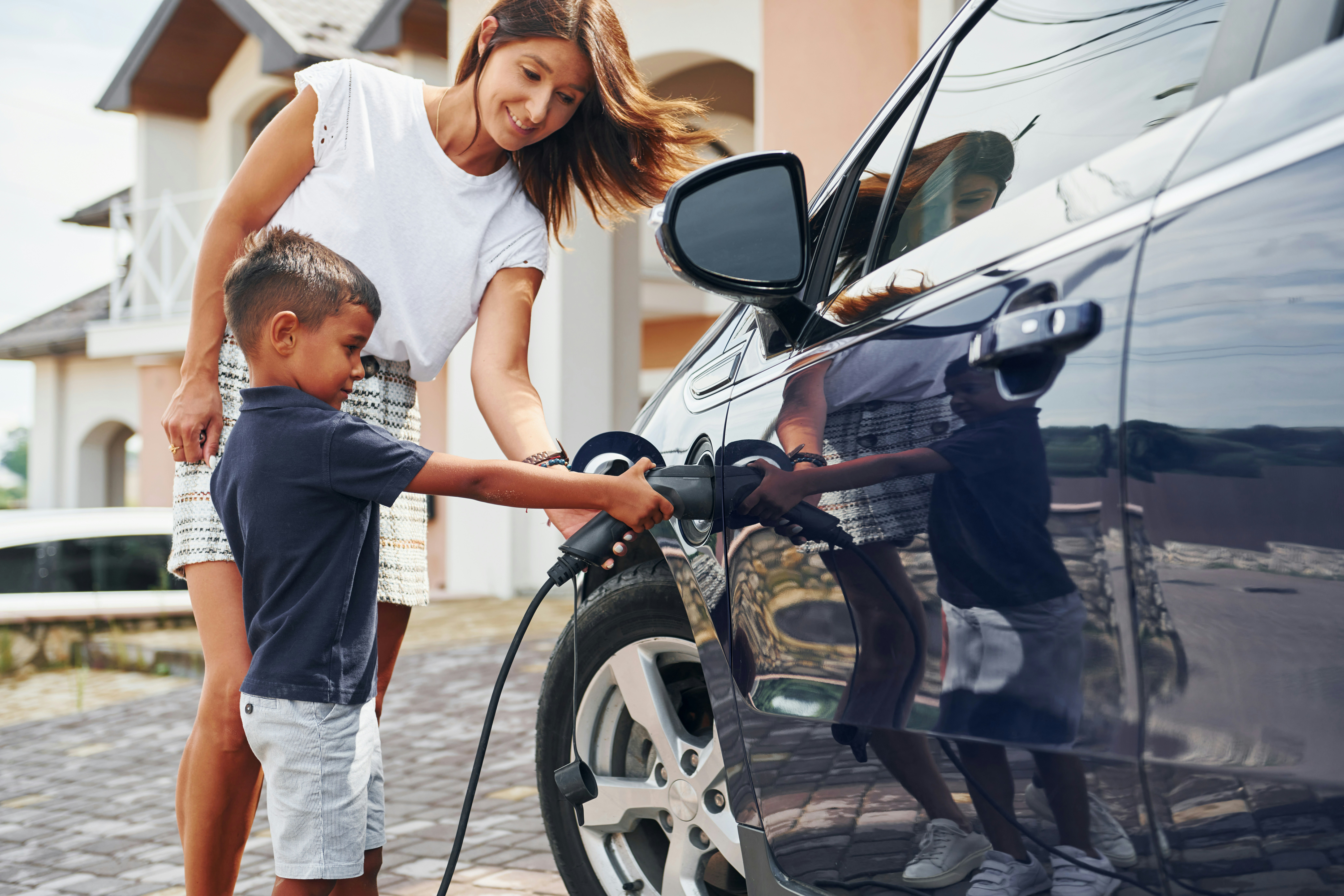
Leasing or buying an EV
Lease or buy a new or used battery electric vehicle to drive.
Equipment and Materials
A fully-electrified battery electric passenger vehicle (EV).
An EV charger. [Optional]
Steps
Lease or buy a new or used EV.
Install an EV charger so you can charge faster. [Optional]
Discussion
As of 2024, fully electrified battery electric passenger vehicles (EVs) are a moderately sustainable choice to complete trips and to transport your personal belongings and passengers. The metals in the batteries, motors, and frame are fully recyclable, and the electricity used to charge the batteries can be generated from sunlight, wind, water, and other natural energy flows. To be superbly sustainable, cycle or take public transit.
Cycling is dangerous in North America because our road infrastructure prioritizes drivers above pedestrians or cyclists. Elected officials have established land-use laws and regulations, creating sprawl, and have restricted funds for public transit, creating inconvenient schedules and unreliable service. This forces people to drive, or to rely on others who can drive, to meet their needs.
Most North Americans cannot afford to buy or lease a new vehicle. For those who can, buying any new fuel-burning vehicle (including plug-in hybrids) is unsustainable because the process of extracting, refining, distributing, and burning fuel destroys resources and creates dangerous pollution. The transition to a sustainable energy future requires replacing our fleet of fuel-burning vehicles with new EVs. Buying a new fuel-burning vehicle delays this transition, whereas buying a new EV accelerates the transition.
A moderately sustainable choice of personal passenger vehicle is either a new or used EV that can operate without burning any fuel. If you cannot afford an EV, a used fuel-burning vehicle is more sustainable than a new one. At least you will not be adding an additional new fuel-burning vehicle to the fleet.
Many people falsely believe that the life-cycle environmental impacts of a new EV are worse than a new non-electrified or semi-electrified vehicle. This is false because an enormous amount of fuel is required to operate a fuel-burning passenger vehicle over its lifetime. Creating and destroying all this fuel has a much bigger impact than creating and recycling a battery.
In 2023, the best-selling new vehicle in the United States was the fuel-burning Ford F-Series pickup truck; the best-selling SUV was the fuel-burning Toyota RAV4; and the best-selling car was the fully electrified Tesla Model Y. A 2023 Ford F-140 pickup burns one gallon of gasoline to go 21 miles; a 2023 Toyota RAV4 gets 30 miles per gallon (mpg); and a 2023 Tesla Model Y burns no fuel but gets the equivalent of 123 mpg from electricity. The average distance a vehicle was driven in the United States in 2022 was 14,489 miles.
Over 20 years, a Ford F-150 will burn 83,802 pounds of gasoline, and a Toyota RAV4 will burn 58,661 pounds. Once this fuel is burned, it is destroyed: none of it is available to be recycled. Furthermore, burning fuel combines one carbon atom with two oxygen atoms, creating much more pollution than fuel consumed. By using a fuel-burning vehicle for two decades, the driver of the Ford F-150 will emit 287,848 pounds of carbon dioxide, and the driver of the Toyota RAV4 will emit 201,494 pounds of this pollution, most of which will persist in Earth’s atmosphere for centuries.
Producing ethanol as a substitute for gasoline is not a sustainable solution because even more material must be consumed to create ethanol than to refine gasoline.
To operate a fuel-burning vehicle destroys tens of thousands of pounds of refined liquids and creates hundreds of thousands of pounds of persistent pollution. By contrast, an EV uses a battery containing less than 2,000 pounds of solid metal and plastic, which are not destroyed by use. The electricity to charge batteries weighs nothing and can be generated from sunlight that reaches spaces where vehicles park. It is an interesting coincidence that a single parking space in Maine covered by solar panels generates as much electricity per year as an average EV uses.
The driver of a fully electrified battery electric vehicle will burn no fuel directly. How much fuel is burned indirectly to generate electricity depends on whether you use your own solar power or grid power. If you buy grid power, how sustainable that is depends on how quickly the United States continues to build clean power plants. Wind power, solar power, and hydropower are the major sources of electricity that consume no fuel. Solar power is growing the fastest, is becoming the most affordable, and has by far the most potential to generate electricity everywhere in the world.
Across the United States in July 2024, more electricity was generated in one month from solar power than has ever been generated in one month from hydropower. Now that solar power, for the first time ever, has joined hydropower and wind as a major source of electricity, the US is on track to eliminate coal as a source of electricity, which will deliver enormous environmental and health benefits to everyone on Earth.
The last time that we generated more electricity from coal than from sources that do not emit carbon pollution was in August 2017. Since 2020, in most months, we have generated more electricity from nuclear power than we have from coal. In 2024, we began generating more electricity from wind than we generate from coal. We’re on track to begin generating more electricity from solar power than from coal in 2025 or 2026.
We can accelerate the shift to solar power by installing solar power to charge EVs. A superbly sustainable way to do this is to build solar carports over sunny private driveways and public lots where EVs park. That would shade and produce power over paved surfaces that otherwise contribute to urban heat islands.
As the United States cleans up its power supply and harnesses perpetual natural energy flows instead of burning fuel to generate electricity, the environmental benefits of driving EVs will become greater and greater. Buying or leasing a new EV helps make the transition to a sustainable future happen faster. An EV can be charged from any electrical outlet, or from solar power. At the end of its useful life, the metals in an EV’s battery, wiring, motors, and frame can be fully recycled.
Definitions
Electric vehicle (EV) charger: equipment that allows an EV to be charged from a 240-volt alternating current source (such as is available in most homes and small businesses to run loads such as electric dryers, ovens, or hot water heaters), enabling faster charging than is possible using a 120-volt electrical outlet (the standard outlet for most plug-in appliances such as lamps and televisions)
Fully electrified battery electric passenger vehicle (EV): a passenger vehicle that has no combustion engine or fuel tank
Mild hybrid: a passenger vehicle with an electric traction motor powered by a battery that can only be charged by burning fuel in the vehicle
Miles per gallon equivalent: a fuel economy measure for EVs that states the distance the vehicle can travel using electrical energy equivalent to the amount of energy available from a gallon of gasoline
Plug-in hybrid: a passenger vehicle with an electric traction motor powered by a battery that can be charged by plugging into a standard 120-volt electrical outlet or an EV charger.
Semi-electrified vehicle: a mild or plug-in hybrid vehicle that gets better fuel economy because energy can be stored and released from a battery, making braking and accelerating slightly more efficient
Troubleshooting
I can’t afford to buy a new vehicle
Buy a used vehicle
Plan trips carefully and rent a vehicle a few times per month
I can’t afford to install an EV charger
Charge your EV with a regular 120-volt outlet; it will just take longer.
I need to take long-distance trips, but EVs aren’t good for those.
Plan extra time to stop for charging along the way.
Rent or borrow a vehicle for long trips.
Take the train or a bus.
I don’t know if my electrical panel can handle charging an EV.
Charge your EV with a regular 120-volt outlet; it will just take longer.
Note the amperage rating of your electrical panel (typically 100 or 200 amps), then add up the amperage of the existing circuits.
Consult an electrician.
I’m worried about what happens if the battery breaks.
Verify the manufacturer warranty; most batteries have an eight-year or 100,000-mile warranty.
Check with local repair shops to see if any of them service EVs.
Strategies and Goals
Movement
Drive electric
Buy or lease an EV
Energy
Increase Energy Efficiency
Drive energy-efficient vehicles
Habitat
Prevent Pollution
Protect environmental health and well-being
Community
Demonstrate Best Practices
Inspire people in your community to drive electric
Milestones
Decrease fuel-burning engine starts
Measure: Starts of fuel-burning engines
Method: Logbook
Time Period: Week
Increase distance driven with electricity
Measure: Driving distance under electric propulsion
Method: Odometer
Time Period: Week
Decrease fuel consumption
Measure: Fuel purchased
Method: Logbook or financial records
Time Period: Year
Increase people driving electric in the community
Measure: Community members driving electric
Method: Logbook
Time Period: Year
Limitations
Not everyone can afford to buy or lease a passenger vehicle.
Affordable Chinese EVs are not allowed to be sold in North America.
Driving a passenger vehicle of any kind is much less sustainable than cycling or walking.
EVs are more expensive to buy, lease, or rent than fuel-burning vehicles.
Fewer styles of EVs are available compared to fuel-burning vehicles.
Charging while towing is inconvenient; most public stations require unhitching a trailer before charging.
Range while towing heavy loads is limiting.
If you park your vehicle on the street, charging becomes more difficult.
Opportunities
Driving 101: Combining Trips
Driving 102: Shopping Online
Driving 103: Taking Transit Instead of Driving
Driving 201: Telecommuting
Driving 202: Renting or borrowing a hybrid vehicle
Driving 203: Using micromobility
Driving 204: Carpooling
Driving 301: Leasing or buying a used hybrid vehicle
Driving 302: Renting or borrowing an EV
Driving 401: Living in a walkable community
References
How do we know how long carbon dioxide remains in the atmosphere?
Life cycle assessment of electric vehicles: a systematic review of literature
Tesla Battery Weight Guide: Tesla Batteries per Tesla Model Answered, Plus Other EV Batteries
U.S. corn-based ethanol worse for the climate than gasoline, study finds
Worth the Watt: A Brief History of the Electric Car, 1830 to Present
Key Words
movement, electric vehicles