Get Cooking with Induction: Faster, safer, and More Energy-Efficient
Induction ranges "generally outperform every other kind of cooktop," according to Consumer Reports' tests.
If you haven’t discovered induction cooking, you’re in for a treat! This technology is three times more efficient than gas stoves, which means you can boil water and prepare meals in less time for less money without exposing your family to unhealthy air pollution from burning methane (natural gas) or propane (bottled gas) where they breathe. Not only that, cleanup is a breeze because the cooktop is smooth—magnets below the glass induce heat inside metal cookware placed over the magnets. So when you remove the hot pot or pan, the stove's surface immediately cools down and is safe to wipe clean. Because you’re using magnetic waves to heat the metal surface of your cookware, you get exquisite control. To help nudge people to upgrade their wasteful and dangerous old gas cooking appliances, the United States federal government is providing $4.5 billion in funding so states can provide rebates for the purchase of efficient new electric appliances, including induction stoves.
Two That Matter Most
To know how well you are meeting your need for cooking without wasting energy or exposing your family to dangerous indoor air pollution, these two indicators matter most:
How much energy you use.
Whether you are burning fuel indoors.
Cooking 101
Using Induction Stoves
Cook using electric induction stoves.
Equipment and Materials
Electric induction cooktop or stove.
Steps
If you are currently cooking with gas, contact the company that delivers it to let them know you are upgrading to an electric induction stove.
Have them disconnect and remove your gas stove.
Decide whether you want to cook with a small cooktop, which can be plugged into a 120-volt regular outlet in your kitchen, or a larger stove and electric oven, which will require a 240-volt outlet.
If you decide you need a 240-volt appliance, make sure you have a large enough electric circuit to supply electricity to it.
If necessary, install a four-wire 240-volt circuit (two hot, one neutral, and one ground).
Buy and install an electric induction cooktop or stove.
Buy compatible cookware, if necessary.
Discussion
Electric induction cooking uses electromagnetism to heat metal cookware, a very safe and efficient technology for boiling water and preparing meals. Induction is three times more efficient than gas because the energy is delivered efficiently via magnetism to the cooking surface that is in contact with the ingredients being heated.
You can buy small induction plates that plug into a 120 V outlet or large induction ranges, stoves, and ovens that require a dedicated 240 V circuit. Whatever the size of the induction cooking appliance, there should be a marking on its surface indicating where the magnetic field will be generated. If a magnet sticks to cookware, that cookware can be used on an induction stove. When you turn on an induction stove element and place cookware in the indicated area, the cookware itself will heat up due to an alternating magnetic field.
Unlike a gas stove, which has energy losses from combustion and heat escaping around and above the cookware placed over an open flame, an induction stove keeps the heat inside the cookware, directly in contact with the ingredients being prepared. The surface of the induction stove is only indirectly heated by the cookware on top; if you move the cookware out of the magnetic field, the stove will cool down even while the magnetic field is still being generated. Many units have a sensor to detect when nothing is in the magnetic field, and it will automatically turn off once you move your pot or pan off the magnet.
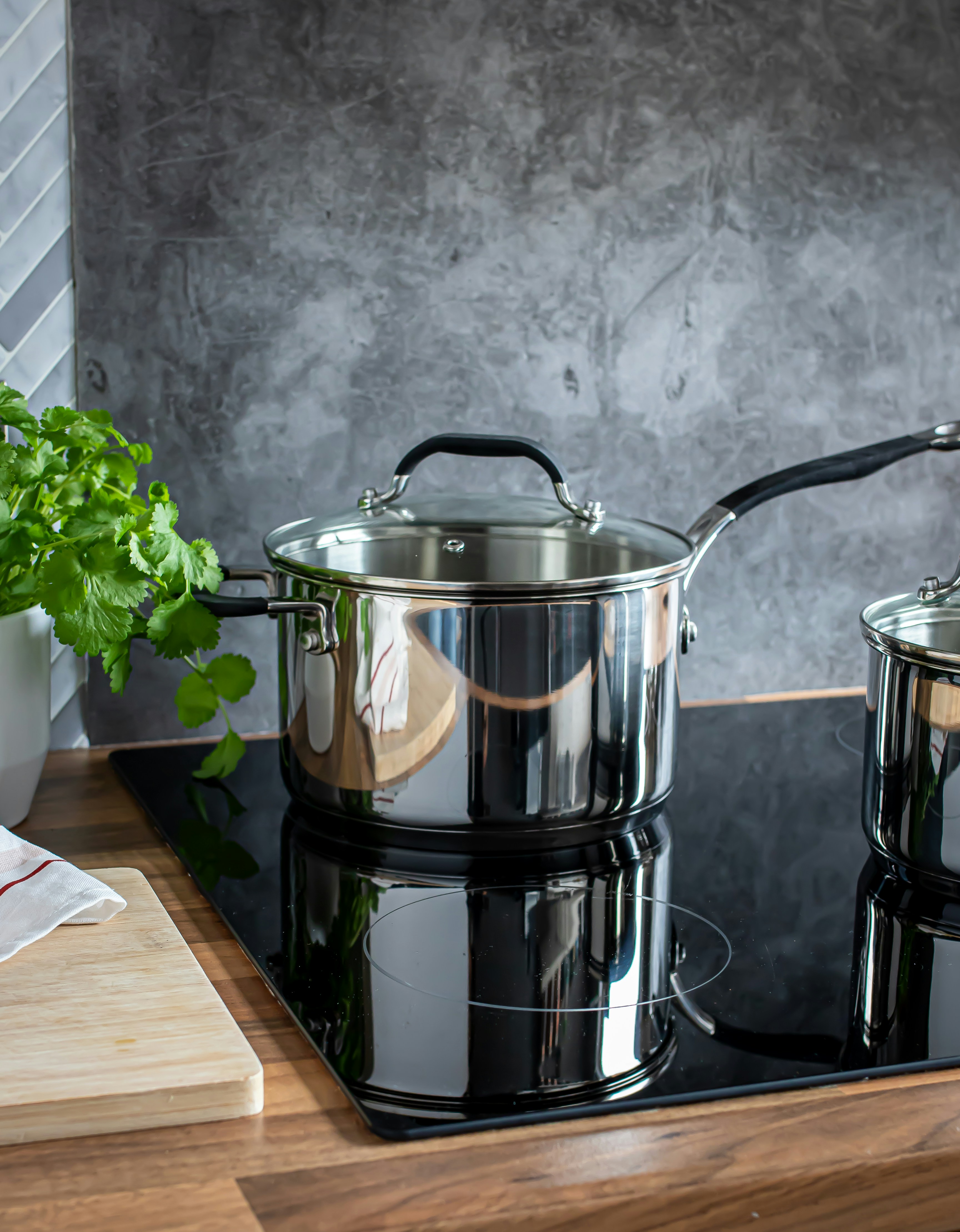
You can very precisely control the temperature while cooking by turning the control to make the magnetic field stronger or weaker. Non-magnetic material, such as your hand, will not heat up in the magnetic field of an induction stove. (But any magnetized metal you’re holding will heat up.) Only metal that can be magnetized will heat up. You can buy aluminum and copper cookware that have magnetic layers specifically designed for induction cooking. Otherwise, use cast iron, stainless steel, enameled cast iron, or magnetic stainless steel (not all stainless steel is magnetic).
Because there is no exposed burner, an induction stove is easier to clean than a gas stove or an exposed electric element stove. Simply wipe off the glass.
Unlike a microwave oven, which cooks food by heating the water molecules inside, an induction stove cooks food by heating the cookware. So, you can use techniques that are very similar to cooking in a pot or pan over a flame. Flat-bottom cookware works best; rounded items like woks might not have enough metal in the magnetic field to heat up evenly.
Check for rebates in your state. The federal government is allocating four and half billion dollars to encourage people to upgrade to energy-efficient appliances, including electric induction stoves.
Definitions
120-volt outlet: regular three-prong outlets can deliver a maximum of 1.8 kW on a 15-amp circuit or 2.4 kW on a 20-amp circuit
240-volt circuit: this is a higher-power circuit that can deliver a maximum of 9.6 kW on a 40-amp circuit or 12 kW on a 50-amp circuit
Induction cooktop: usually a smaller, portable appliance that can plug into a 120-volt outlet
Induction stove: usually a larger appliance that requires a dedicated, high-power 240-volt circuit
Troubleshooting
You hear a high-pitched hum when you cook on induction
Try adjusting the control knob; sometimes, cooking at full strength causes resonance.
Settle the cookware (move it slightly) so it does not vibrate.
Try a different pot or pan that has a flatter bottom.
Your cookware isn’t heating evenly
Make sure it is magnetic.
Try using another pot or pan that is more magnetic.
Make sure you’re centering the cookware over the magnet.
Your induction stove suddenly stops heating and then starts again
Power cycling at full strength might be normal operation; check your owner’s manual.
You trip a breaker when using your induction stove
Call an electrician to check the circuit.
Upgrade your wiring to a larger gauge, and increase your breaker size. Only do this if you can understand your local electrical code book! Note: With the installation of any high-power electrical appliance, wire gauge, length, and breaker size must be carefully selected to reduce the risk of electrical fires.
Strategies and Goals
Community
Educate
Become an induction cooking expert
Demonstrate best practices
Inspire people in your community to cook with induction
Energy
Increase energy efficiency
Use electricity more efficiently
Milestones
Increase environmental literacy
Measure: Knowledge relevant to induction cooking
Method: Quiz
Time Period: Season
Increase people cooking with induction in the community
Measure: Community members cooking with induction
Method: Logbook
Time Period: Year
Stop burning fossil fuel
Measure: How much fossil fuel you buy
Method: Fuel bills
Time Period: Month
Decrease energy use
Measure: How much energy you buy
Method: Fuel and electricity bills
Time Period: Month
Limitations
Induction cooking requires compatible cookware.
Large induction stoves require sufficient power; some homes may need to upgrade their electrical service or run new circuits.
Not everyone can afford to replace their stove and oven.
Opportunities
Cooking 102 - Using Microwave Ovens
Stop using fossil fuel to cook
Increase energy efficiency
References
Articles
Rebates
Induction Cooktops and Stoves
Keywords
Cooking, induction stove, induction range, induction cooktop, energy efficiency, indoor air quality