Clean Green to Transform Your Home: Cleaning 101 Provides Safe, Eco-friendly Solutions
Green cleaning can help reduce the nearly $2.3 billion in U.S. healthcare costs due to unintentional ingestion of toxic household chemicals.
Our one step this week is Cleaning 101: Using Safer Solutions. Like last week’s practice (Drinking 101: More Tap Water, Fewer Bottled Beverages), this is a practice everyone can afford—plus it would lower healthcare costs if widely adopted. Green cleaning protects the well being of our natural environment and the people we love who are living in that environment.
Two That Matter Most
To know whether you are meeting your need for cleaning in a sustainable way, these two environmental indicators matter most:
How much money you spend on “green” cleaning solutions.
How much money you spend on harsh chemical cleaning solutions.
Sustainable Practice: Cleaning 101
Using Safer Solutions
Clean using effective tools and techniques, including aqueous solutions of homemade and plant-based biodegradable compounds free of unnecessary perfumes or dyes and without synthetic antibiotic chemicals. Buy dry supplies in bulk to reduce packaging waste.
Equipment and Materials
Water
Applicators, abrasives, and buffering agents
Brush
Plant fiber abrasive pad
Steel wool (optional)
Salt (sodium chloride)
Cornstarch
Alkaline salts
Baking soda (sodium bicarbonate, pH 8.5 in water)
Borax (sodium tetraborate, pH 9.5 in water)
Washing soda (sodium carbonate, pH 11 in water)
Acids
Vinegar (acetic acid, pH 2 to 3)
Lemon juice (citric acid, pH 2 to 3)
Club soda (carbonic acid, pH 3 to 4)
Hydrogen peroxide (pH 3 to 6)
Oils
Olive oil
Canola oil
Lavender oil (optional)
Tea tree oil (optional)
Other “essential” oils (optional)
Surface-active agents (surfactants)
Castile soap (from vegetable oils and lye)
Disinfectants
Rubbing alcohol (isopropyl alcohol)
Enzymes
Cold-water enzymes for washing clothes (optional)
Warm-water enzymes for washing dishes (optional)
Steps
Learn how to make your own cleaning supplies from abrasives, alkaline salts, acids, oils, surfactants, and disinfectants.
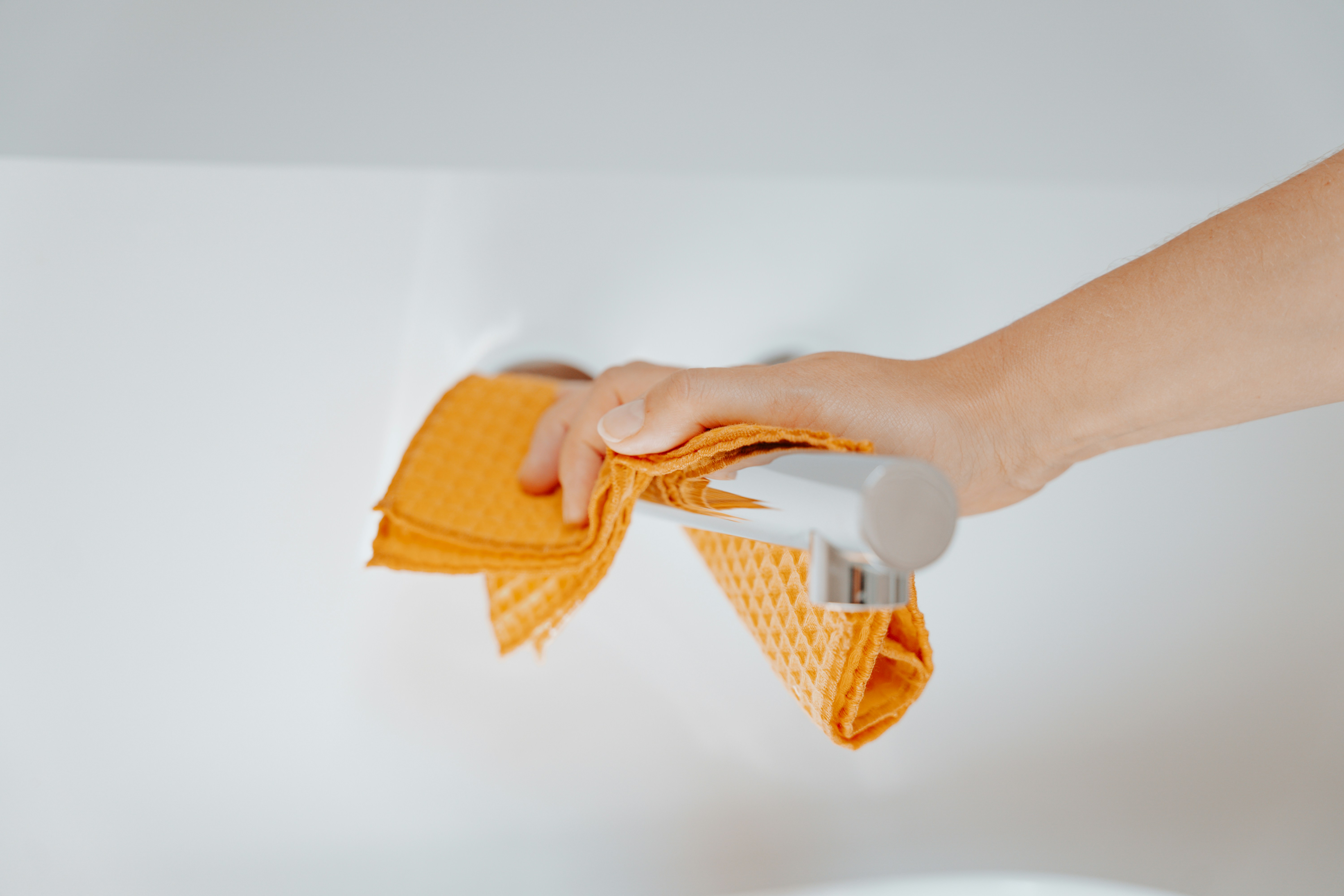
Use microfiber cloths and cellulose sponges to wipe off surfaces.
Buy a supply of alkaline salts, acids, oils, surface-active agents, and disinfectants so you can make your own cleaning solutions.
Clean with plant-based commercial cleaning solutions or make your own.
Discussion
Cleaning without using harsh chemicals (e.g., ammonia, bleach, or antibiotics), dyes, or fragrances is an opportunity to buy green goods, protect water quality, demonstrate sustainable practices, and safeguard the health and well-being of everyone in your household or organization. Effective cleaning physically removes viruses, bacteria, fungi, and other undesirable organisms, the habitat (dirt and food) that harbors them, and stains and grime. At a fundamental level, cleaning means moving material from inside to outside. Safe cleaning practices keep harmful chemicals out of your compost, garbage, and wastewater.
Brushing, dusting, sweeping, and vacuuming can remove dry dirt and debris. Plain water can dissolve and remove many other materials, such as mud, sugars, and starches. Aqueous alkaline and acidic solutions can handle almost every other cleaning chore. To kill viruses, bacteria, and fungi on contact, you can use disinfectants like rubbing alcohol or hydrogen peroxide. In most cases, it’s unnecessary to try to kill these microorganisms when you can remove them and their habitat from your body, clothing, dishes, furniture, and floors. Furthermore, if you use antibiotics unwisely, you may breed dangerous antibiotic-resistant strains of bacteria that no one can control.
Split microfiber cloths made from a blend of polyester and polyamide have several advantages over sponges, disposable paper towels, or towels made from larger natural fibers:
Electrostatically attract dirt and grease, so they can clean without water.
Pick up more dirt and food residue per towel because the smaller fibers have more surface area.
Absorb more water.
Dry faster.
Produce no lint.
Can be washed and reused 1,000 times or more.
You can test whether a microfiber cloth is good for cleaning by pushing a bead of water with it. Microfibers designed to clean will absorb the water, whereas other types will repel water. Soiled microfiber cloths should be washed in hot water using detergent (which rinses clean), not soap (which can leave residue), without fabric softener. This ensures that the microfibers release all the particles, oil, and grease stuck to them. Do not put microfiber cleaning cloths in a dryer with cotton or other natural fibers; small pieces of lint will stick to them.
Knowing chemistry empowers you to make your own cleaning solutions that are safe, effective, and affordable. It is good practice to use the mildest ingredients (closest to a neutral pH of 7) to get the job done. Here are a few basic recipes. Note: a “part” is a unit of volume; you can scale these recipes to make a larger or smaller volume depending on your cleaning needs.
Mild-strength all-purpose Cleaner (Acid)
1 part vinegar
8 parts warm water
Mild-strength all-purpose Cleaner (Alkaline)
1 part baking soda
8 parts warm water
Medium-strength all-purpose Cleaner (Alkaline)
1 part borax
8 parts warm water
Full-strength, all-purpose Cleaner (Alkaline)
1 part (½ teaspoon) washing soda
1 part (½ teaspoon) castile soap
192 parts (2 cups) warm water
Note: you may come across “green cleaning” recipes that mix an acid, such as vinegar, and a base, such as baking soda, together. Mixing acetic acid and sodium bicarbonate produces carbon dioxide gas, water, and sodium acetate, which is not a very effective cleaning solution once the carbon dioxide has bubbled out; however, it is effective to use an acid cleaner and then an alkaline cleaner, or vice versa, if you keep the solutions separate. Doing so allows the first solution to break down compounds and then the second solution neutralizes to prevent chemical reactions from continuing.
Unlike acids and bases, which chemically decompose molecules, the underlying method of action for soap and detergents is to be a surface-active agent (surfactant), attaching on one side to hydrophobic particles and on the other side to water molecules. With a detergent or soap molecule attached, a hydrophobic particle can be removed and rinsed down the drain with water. You can make your own soap from oil and lye or buy plant-based detergents that are less likely to leave soap residue on surfaces. Modern formulations of laundry detergents and dish soap often include hydrolase enzymes produced by yeasts, other fungi, or bacteria that make it easier for water to attach to and remove dirt, food, and grime from clothes and dishes.
Non-stick cookware is marketed as easy to clean, but a better alternative is cast iron cookware, which is also easy to clean when properly seasoned with vegetable oil. Learn how to clean cast iron without removing the non-stick oil seasoning.
To avoid buying unnecessary plastic packaging, buy dry alkaline salts in cardboard boxes and buy laundry detergent as a sheet or powder in a cardboard box rather than as a liquid in a plastic bottle. If you buy commercial “green cleaning” products, look for concentrates that you can mix with water.
Definitions
Acid: substances that release hydrogen cations (H+) in solution, lowering pH, neutralizing alkaline salts, and tending to decompose molecules
Alkaline salts: substances that accept hydrogen ions in solution, raising pH, neutralizing acids, and tending to decompose lipids and proteins
Antibiotic: substances that kill microorganisms or inhibit their growth
Aqueous solution: substances (often salts) dissolved in water
Biodegradable: material that biological systems can naturally break down into safe and inert components
Detergent: a surfactant that is effective in dilute solution, often synthetic
Enzyme: a catalyst, usually a protein, that speeds up chemical reactions
Hydrolase: an enzyme that uses water to break chemical bonds
Hydrophobic: molecules that are insoluble in water
Lipids: organic compounds with at least one hydrophobic part, including fats and waxes
Proteins: large molecules usually produced by living cells
Salt: a chemical assembly of cations and anions
Soap: a surfactant that is a salt of a fatty acid; a type of detergent
Split microfiber: cloth made from synthetic fibers, such as polyester and polyamide, that are split during manufacture to create multi-stranded fibers thinner than 10 micrometers
Surface-active agent (surfactant): a chemical compound, such as a soap or detergent, that has a water-repelling and water-attracting part
Troubleshooting
Green cleaning products are too expensive:
Make your own using affordable acids, alkaline salts, and plant-based detergents.
Green cleaning solutions don’t work as well as ammonia and bleach:
Apply a green cleaning solution and let soak.
Make sure your green cleaning recipe doesn’t mix an acid and a base in the same solution.
Change formulations to use more acidic or more basic chemicals.
Hire a cleaning professional to advise.
You can’t find green cleaning products in your local grocery stores:
Shop online for borax, washing soda, etc.
Strategies and Goals
Community
Educate
Become a green cleaning expert
Demonstrate best practices
Inspire people in your community to clean green
Water
Protect water quality
Reduce harsh chemicals in your wastewater
Keep antibiotics out of your wastewater
Goods
Buy green
Avoid buying unnecessary synthetic chemicals
Reduce plastic packaging purchases
Milestones
Increase purchases of green cleaning supplies
Measure: Cleaning supplies purchased
Method: Logbook
Time Period: Month
Decrease purchases of unsustainable cleaning supplies
Measure: Cleaning supplies purchased
Method: Logbook
Time Period: Month
Decrease liters of garbage sent to incinerate or landfill
Measure: Waste sent to incinerate or landfill
Method: Logbook
Time Period: Week
Increase environmental literacy
Measure: Knowledge relevant to green cleaning
Method: Quiz
Time Period: Season
Increase people cleaning green in the community
Measure: Community members cleaning green
Method: Logbook
Time Period: Year
Limitations
Lack of time may require buying commercial formulations.
Cleaning services may not be willing or able to use green formulations.
Opportunities
Cleaning 102 - Make Your Own Soap
Learn more about green cleaning
Have fun
References
Articles
Keywords
cleaning, antibiotics, detergent, enzymes, microfiber cloth, soap, surfactant, wastewater