An Insight Into 'The Slow Demise of Green Energy?'
Despite recent headlines, green energy is growing and electric vehicles are working well for more people every year.
If you watch Fox News or read the Wall Street Journal, you might think that renewable energy and electric vehicles are not quickly gaining market share. Articles like “The slow demise of green energy?” and “Tesla vs. Toyota Is the New Hot Battle in Cars” seem to cast doubt on the wisdom of going solar and driving electric. In this insight, my goal is to help you understand what’s really happening so you can help your friends and family stay focused and motivated to make great progress on pathways to a sustainable future.
Some Green Power Facts
Among all trustworthy sources of information for understanding how the world is making the move to green energy, three organizations stand out. Global Energy Monitor (GEM) collects, organizes, and shares verifiable facts about the international energy landscape. The International Energy Agency (IEA) and the United States Energy Information Administration have the difficult task of predicting the course of the transition from fuel to solar power.
Every year, the IEA publishes the World Energy Outlook (WEO), which attempts to predict how the world will meet its needs for power in future decades. In 2017, Jeff Desjardins wrote “Experts are Hilariously Bad at Forecasting Solar Installations,” noting that the actual amount of photovoltaic (PV) solar capacity added each year, according to the Photovoltaic Market Alliance (PVMA), is consistently many more billions of watts (GW) than the IEA WEO predictions.
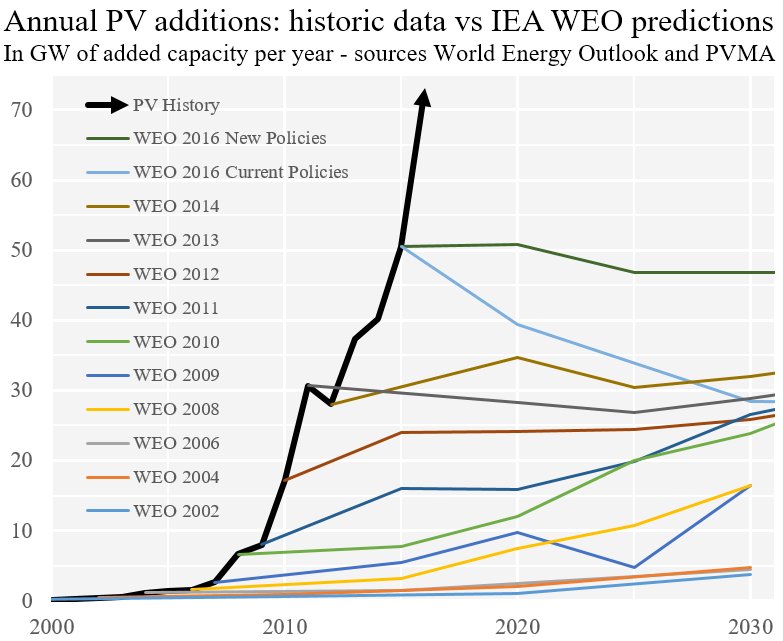
The chart above shows how many gigawatts of solar capacity the world has been adding per year (the thick black line) compared to predictions (the colored lines). Year after year, the world has been adding solar power at a much faster rate than predicted, and the rate has been accelerating. Rather than a “slow demise,” green energy has been experiencing “fast growth.”
GEM’s Global Solar Power Tracker reports that the world currently has 1,671 GW in solar prospects—and that’s just for large utility-scale solar farms. The number of planned rooftop solar or community solar gardens is harder to track. But we can get some idea by observing that the IEA now predicts the world will have the capacity to manufacture 1,000 GW of solar modules per year by 2025. While there are supply chain concerns, mainly around China’s dominance in the market, there are no shortages of the materials necessary to make photovoltaic solar modules—and the more solar modules we make, the more power available to make more modules.
In 17 years, from 2005 to 2022, our world went from installing approximately zero billion watts of solar power to 240 billionper year, but even that phenomenal amount of solar power per year is likely to be exceeded as we increase our solar module manufacturing capacity and we train more electricians and technicians to install them. Unlike hydropower or wind, solar power can be installed anywhere at any scale. You can hang a few panels over your balcony to charge your personal electronics and power tools or subscribe for a share in a massive solar farm to power your whole business and household.
At the same time solar power has taken off, coal power has plummeted.
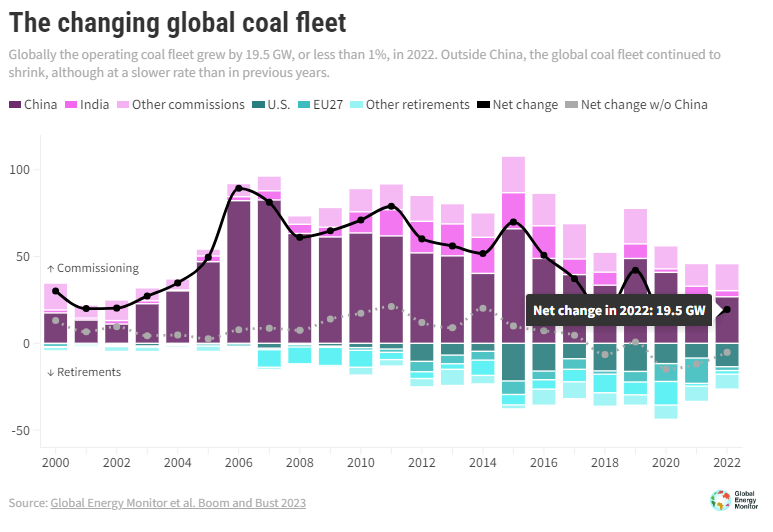
Anti-renewable commentators often cite the fact that coal power plants are still being built in Asia as evidence for spurious arguments against green energy. But as the above chart shows, the total capacity of global coal power additions peaked in 2015 at around 100 GW. Over the 17 years when solar power has grown from 0 to 240 GW per year, net installations of coal power have dropped from around 100 GW to less than 20 GW per year. In 2022, the total amount of new coal power plant capacity installed was less than 50 GW, and about 30 GW of coal power was retired. It is hard to predict the future, but coal power and solar power are headed in opposite directions.
Capacity (how much power is possible) is one thing, but operations (actually generating electricity) are another. The data for coal and solar electricity generation in the United States show that coal power is shrinking while green power is growing—and at an incredible rate.

The United States has been generating electricity from hydropower since the 1800s. But in less than a decade, the amount of electricity we generate from solar power in our country has caught up and exceeded what we get from all our hydroelectric power plants. In other words, over the course of two presidential terms, we’ve doubled our green power production without damming any more rivers. With billions of watts of planned additions, solar is just starting to take off. Imagine how much solar power we can generate if we really get serious! Take a look around your town. How many sunny roofs, driveways, sidewalks, or parking lots could go solar? Every inch of sunny pavement could be covered with a solar module to provide shade and make electricity.
Some Electric Vehicle Facts
According to the IEA’s Global EV Outlook 2023, “A total of 14% of all new cars sold were electric in 2022, up from around 9% in 2021 and less than 5% in 2020.” In the United States, fully electric vehicles have only been manufactured at scale for five years so it’s not surprising that they still have a ways to go to catch up to all the fuel-burning ones that have been made over the past century. Vehicle registration counts for 2022 show the ratio of gasoline vehicles to fully electric vehicles was 100 to 1: more than 240 million gas vehicles were on the road compared to 2.4 million battery EVs.
All modern vehicles have a battery and electric motors for tasks like starting a fuel engine or moving wiper blades. The term “electrified vehicle” means a vehicle with a battery and electric motor powerful enough to turn its wheels, i.e., an electrified drivetrain. Fully electric vehicles have only a battery and electric motors; they do not use any fuel at all. “Hybrid” vehicles combine an electric drivetrain with a fuel-burning drivetrain. If the battery in a hybrid can be recharged by an electric plug, the vehicle is a “plug-in” hybrid in which fuel is optional; otherwise the vehicle is a “fueled” hybrid which requires refueling to keep operating.
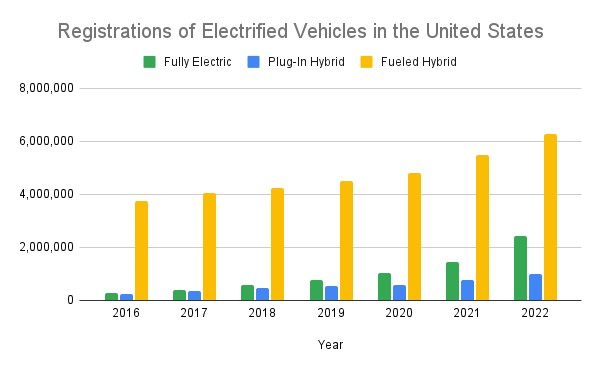
A simple chart of vehicle registrations might look like hybrid vehicles are holding their own against fully electric (battery-only) vehicles. Charting the ratio of both types of hybrids to fully electric vehicles paints a different picture.
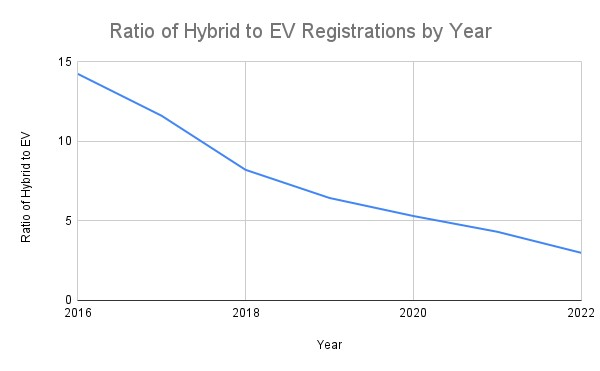
Year over year, there are fewer hybrids per fully electric vehicle because sales of fully electric vehicles are growing at a faster rate. Early adopters have strongly preferred fully electric vehicles to hybrids. But as EVs become more mainstream, numerous news articles have noted that range anxiety has emerged as a key concern. Hybrids allow drivers to fall back on fuel if necessary to reach their destination. But two other solutions also eliminate range anxiety: first, increase the range of EVs, and second, build out a dependable and ubiquitous charging network.
The United States now has several new car companies, including Tesla and Rivian, dedicated exclusively to designing, manufacturing, and selling hundreds of thousands of fully electric vehicles per year in this country. In addition, incumbent manufacturers like General Motors and Ford have long-term strategies for fully electric vehicles.
Those long-term strategies make sense because fully electric vehicles can be charged at home or work, never requiring a trip to a fuel station, and get the fuel economy equivalent of up to 140 miles per gallon. It’s much less efficient to burn fuel—even the best hybrids get less than 70 miles per gallon. For the millions of people in the United States who can charge their cars from sunlight while parked, fully electric vehicles save time and money and avoid the hassle of dealing with fuel. Better battery technology and greater numbers of public charging stations are making fully electric vehicles more attractive to a larger fraction of American car buyers.
What Can We Learn From Headlines?
Although they are not designed to educate us about the true facts of green energy and electric vehicles, opinion pieces and news stories with headlines casting doubt on green energy and fully electric vehicles are illuminating the challenges we face as we phase out fuel. Our global economy is turning toward sunlight for power—but rather than happening in a straight line, this transition is proceeding in exponential surges and sags. At times, we’re making unbelievably significant forward progress, and at times we’re losing ground.
The sharp spike in interest rates is delaying some green power projects, especially off-shore wind, which won’t be competitive with solar power in the long run. The drastic reduction in government subsidies is dampening some demand for green power installations, especially for rooftop solar in California, which for years enjoyed unsustainably lavish subsidies. Toyota is trying to spin its bad bet on hydrogen fuel cell technology as a prudent “all of the above” strategy (similar to President Obama’s unfocused energy strategy) while squeezing every last dime out of its outdated hybrid technology. But overall, advances in solar modules, electric motors, computer chips, and batteries and a focused energy policy prioritizing renewable power are enabling more people to use green power to meet more of their needs.
One fear behind the headlines is that we can’t live without fuel. Another fear is that we may lose all the money we’ve invested to develop fossil fuel reserves. Both fears are powerful but groundless. If you believe fuel is essential for your safety and survival, fully electric vehicles are terrifying. What will happen to your neighborhood gas station if all your neighbors start driving electric? Who will service your gas car if your local car dealership stops selling them? As more and more people drive electric cars, and as technology and infrastructure improve to provide longer ranges and convenient charging, some fears will melt away, and others will become more intense. Most people will see that it is possible to live well without fuel, but some will not want to—and some will lose their livelihoods as the need for fuel evaporates.
Some investments in “developing” (i.e., finding and extracting) fossil deposits of coal, petroleum, and natural gas will not be lost because these natural resources can be made into carbon-rich products such as steel (a mixture of carbon and iron), graphite, plastics, and pharmaceuticals. Rather than burn through our finite reserves of fossilized plant and animal matter, we’ll fashion them into fully recycled materials (like steel) that we can use for millennia. But many investments in fuel infrastructure may well become “stranded” (i.e., become worthless) because the demand for fuel will dissipate. My own household is an example of how quickly fuel demand can permanently disappear: the week we removed our oil boiler and bought an electric car, our fuel demand went from hundreds of gallons per year to zero.
As sustainability champions, a constructive role we can play is to listen carefully to the fears people are expressing and help dispel fears that are unfounded and mitigate fears that are grounded in reality. The idea that we can live fuel-free lives that are richer and better takes a while to be understood and accepted. People and companies who supply fuel will lose customers—perhaps very rapidly and with little advance warning. We can help more people overcome their irrational and rational fears faster by stepping up to be among the first to transition from burning fuel to harnessing clean, renewable sunlight to meet our needs in perpetuity.
References and Further Reading
The slow demise of green energy?, Fox News
Tesla vs. Toyota Is the New Hot Battle in Cars, The Wall Street Journal
Experts are Hilariously Bad at Forecasting Solar Installations, Visual Capitalist
Global Solar Power Tracker, Global Energy Monitor
Is there enough global wind and solar PV manufacturing to meet Net Zero targets in 2030?, IEA
Global solar installations hit 240 GW in 2022, PV Magazine
Boom and Bust Coal 2023: Tracking the Global Coal Plant Pipeline, Global Energy Monitor
Tesla Production And Deliveries Graphed Through Q4 2018, InsideEVs
Vehicle Registration Counts by State, Alternative Fuels Data Center
E.V. Range Anxiety: A Case Study, The New York Times
The end of range anxiety: how has the range of electric cars changed over time?, Sustainability by Numbers
Tesla Superchargers Growing Phenomenal 33% Year Over Year, CleanTechnica
Electrification, General Motors
The Ford Electric Vehicle Strategy: What You Need To Know, Ford
2023 Hyundai Ioniq 6, Car and Driver
Global hydrogen car sales continue to fall amid collapse in South Korean market, despite surge in China and US, Hydrogen Insight
New Report: The All-of-the-Above Energy Strategy as a Path to Sustainable Economic Growth, President Barack Obama
Summary of Inflation Reduction Act provisions related to renewable energy, EPA