Better Indoor Air Quality, Less Wasted Energy
Use recovery ventilation to replace stale air with fresh air, and keep 80% of the energy in the exchange.
When we think about air pollution, most of us imagine a smokestack or a tailpipe. But according to a growing body of scientific evidence, we’re exposed to more pollution indoors than outdoors, even if we live in big, industrialized cities. So how can we protect indoor air quality and let in enough fresh outdoor air for our health and well being without driving up our air conditioning and heating bills?

Along the energy pathway, this week we’re exploring steps to improve the air we breathe and our energy parsimony. The most important step is to ventilate our buildings efficiently, so we get more value from every kilowatt hour. (If you’d like a refresher on what a kilowatt hour is, check out “First Steps to Endless Energy.”)
Heat or enthalpy recovery ventilation is a particularly clever step that allows us to bring in lots of filtered fresh air without wasting energy—protecting our health, our planet, and our wallets. We can also take other steps to ensure that we’re breathing clean, healthy air for the 21 hours a day, on average, we spend indoors:
Install smoke alarms and carbon monoxide detectors on all floors.
Prevent smoking indoors.
Test for radon; take mitigation steps if necessary.
Eliminate sources of indoor air pollution, such as fuel-burning appliances, scented candles, and air fresheners.
Choose paints, finishes, and cleaning products with little or no volatile organic compounds (VOCs).
Avoid parking fuel-burning vehicles or storing fuel-burning equipment in attached garages.
Verify that chimneys and flues allow exhaust fumes to escape.
Tightly seal basement walls, windows and entrances to reduce the amount of water and humidity entering.
Use exhaust fans in kitchens and bathrooms when cooking and showering.
Open windows or doors if indoor air feels stuffy or smells bad.
Grow indoor herbs or houseplants.
Operate an air purifier.
Weekly Poll: Enough Fresh Air?
Help! My son has asthma; what can we do to improve our indoor air quality?
When I had a sustainable living store in Brunswick, Maine, many of our customers had developed lung disease or sensitivities to common household chemicals. I recommend the following resources if anyone in your family or organization has a health condition like asthma, chronic obstructive pulmonary disease, or idiopathic environmental intolerance (formerly known as multiple chemical sensitivity):
National Heart, Lung and Blood Institute
American Lung Association
McGill Office for Science and Society
I’ve heard that California has banned gas stoves because they are too dangerous. Is that true?
Sort of. On April 17, 2023, the 9th Circuit Federal Court of Appeals decided that Berkeley, California, could not enact a building code that prohibits natural gas piping into new buildings. The Berkeley City Council had voted in 2019 to adopt an ordinance “prohibiting natural gas infrastructure in new buildings with an effective date of January 1, 2020,” in part because three years earlier the Community Environmental Advisory Commission had recommended phasing out natural gas appliances in new buildings for climate, health and safety reasons.
While gas stoves are not banned, as fuel-burning appliances they do pose several dangers that electric appliances do not:
Propane and natural gas are highly explosive—every year hundreds of natural gas explosions damage property or injure or kill people. Ethyl mercaptan, which has a strong and distinctive odor, is added to gas supplies so that if there is a leak you can smell it, get out of your home, and report it to your gas supplier.
Burning fuel creates poisonous carbon monoxide (CO) gas—every year CO poisoning in the United States kills 420 people and sends more than 100,000 people to emergency rooms.
Propane gas is heavier than air; it can pool and asphyxiate your family.
Natural gas is lighter than air; it can become trapped and asphyxiate your family.
You can protect your family against all of these dangers by upgrading
gas ovens and stoves to electric ovens and induction stoves,
gas water heaters to electric hybrid heat pump water heaters,
gas clothes dryers to efficient electric heat pump dryers, and
gas furnaces to electric heat pumps.

Health and safety are probably the two most important reasons for most people to upgrade from gas to electric appliances—but a nice bonus is that going electric also saves energy. Not only are all of the modern electric appliances on the list above more energy efficient themselves than the old-fashioned gas appliances they replace, but they also do not require combustion air. Any time you install gas in a building, you must poke at least one hole through a wall or ceiling for a flue to send exhaust pollution out of the building (where it can kill people) into the neighborhood (where it can be tolerated).
Exhaust flues for gas appliances complicate ventilation and make it harder to keep a building warm in the winter and cool in the summer. When you have all electric appliances, you do not need to put holes through your walls or ceilings, your ventilation system can be simpler and more reliable, and your whole building can be much more energy efficient.
Help! I don’t know whether I should get a heat recovery ventilator or an enthalpy recovery ventilator, or whether I even need either one.
A recovery ventilator is a mechanical ventilation system that blows two airstreams, stale exhaust air from indoors and fresh make up air from outdoors, right next to each other so that heat only (in a heat recovery ventilator) or heat and humidity (in an enthalpy recovery ventilator) can transfer from one to the other. If you run a recovery ventilator when you are heating or cooling indoor air, this lets you recover some of your heating or cooling energy rather than sending it all out with your exhaust air.
Ventilation fans are generally a good idea in modern, well-built residential structures and in pretty much all commercial structures. In poorly built residential structures, you’ll have so much uncontrolled infiltration (i.e. outside air leaking in all the time) that you might not need a fan outside of the kitchen and bathrooms. But if you tighten up a leaky home with weather-stripping and insulation, then mechanical ventilation might be necessary to ensure excellent indoor air quality. Commercial structures often have dozens or hundreds of people in them. With that many people in an enclosed space, levels of carbon dioxide and humidity can spike without mechanical ventilation.
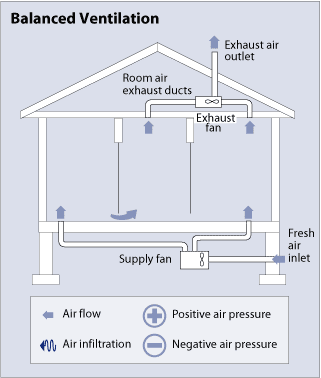
Recovery ventilators are the most sophisticated of the four kinds of mechanical ventilation you can choose:
Exhaust only ventilation. Fans blow air out of a building. With your building depressurized, fresh air will come in wherever it can through windows, doors, walls, and ceilings. This works better in cold climates than hot climates.
Supply only ventilation. Fans blow air into a building. With your building pressurized, stale air will go out wherever it can through windows, doors, walls, and ceilings. This works better in hot climates than cold climates, and has the benefit that supply air can be filtered to remove particulates and other pollution.
Balanced ventilation. Exhaust fans blow air out and make up air fans blow air in, but the airstreams are not in close proximity. If the fans move air at the same rate, your building will be at equilibrium pressure. This works well in all climates, and all incoming air can be filtered.
Recovery ventilation. This is a balanced ventilation system that sends the exhaust and make up airstreams through a heat exchanger or a heat and humidity exchanger, so that the outgoing air tempers the incoming air, recovering 70% to 80% of the available energy in the airstream. This works well in all climates, filters incoming air, and improves cooling and heating efficiency.
Here are a few questions to ask to decide what kind of ventilation system makes the most sense for your situation:
Is there enough uncontrolled infiltration (air leaks) to provide enough fresh air, without mechanical ventilation, for the number of people who use the structure?
Will an exhaust-only ventilation strategy lead to mold and mildew problems in walls and other areas where hot humid air comes in contact with cool surfaces?
Will a supply-only ventilation strategy cause uncomfortable drafts or high heating bills?
Are you able to change filters and maintain your ventilation system?
Is your structure located in a mild climate where heat or humidity recovery offer limited benefit?
How expensive will it be to install the ducting necessary for a heat recovery ventilator (HRV) or an enthalpy recovery ventilator (ERV)?
How difficult will it be to clean and maintain the heat exchanger in an HRV, or the heat and humidity exchanger in an ERV?
Can you swap the exchange core in your recovery ventilator so that sometimes it can operate as an HRV and other times it can operate as an ERV?
If you live in a mild climate, you spend little energy on heating and cooling. A balanced ventilation system without heat recovery is probably the most sensible way to ensure good indoor air quality. If you spend a lot on heating or cooling, then an ERV or a recovery ventilator with a swappable core is probably best. But you may find that the expense and hassle of installing and maintaining a recovery ventilator is too much for the energy savings it can deliver. In that case, it’s even more important to take every other sustainable step you can for healthy indoor air quality.
What’s Still Ahead on the Pathway…
Earlier this year, we explored the pathway to sustainable movement; now, we’re exploring the related pathway to sustainable energy. What are the best ways to save, use, and make energy? Stay with us on the journey to sustainability as we take action to have a positive impact on the world.
References and Further Reading
The Inside Story: A Guide to Indoor Air Quality, US Environmental Protection Agency
Being Sustainable, Fred Horch
First Steps to Endless Energy, Fred Horch
Indoor Air Quality, US EPA
The Best Carbon Monoxide Detector Placement for Your Home, ADT
Health Effects of Secondhand Smoke, American Lung Association
Radon and Your Health, US Centers for Disease Control and Prevention
We need to talk about your gas stove, your health and climate change, NPR
Cozy Sources of Indoor Air Pollution Examined: Candles and Fireplaces, Filtrete
Air fresheners: Are they safe?, National Capital Poison Center
Exhaust ventilation in attached garages improves residential indoor air quality, Indoor Air
Furnace Exhaust Vent Blocked? Here’s What to Do, HVAC Training Shop
Houseplants purify air, but not as much as you’d think, Popular Science
The Best Air Purifier, New York Times
What Is Asthma?, National Heart, Lung, and Blood Institute
Learn More Breathe Better, National Heart, Lung, and Blood Institute
Clean Air, American Lung Association
Zeroing in on the Cause of Multiple Chemical Sensitivity, McGill Office for Science and Society
CALIFORNIA RESTAURANT ASSOCIATION, a California nonprofit mutual benefit corporation, Plaintiff-Appellant, versus CITY OF BERKELEY, Defendant-Appellee, US Court of Appeals for the Ninth Circuit
Berkeley first city in California to ban natural gas in new buildings, Berkeleyside
Preventing Natural Gas Explosions, Miller, Weisbrod, and Olesky
Is Propane Heavier Than Air?, Paraco
Propane Toxicity, Poisoning Symptoms, and How to Avoid Exposure, The Propane Education & Research Council
What is Natural Gas?, Connecticut Department of Energy and Environmental Protection Public Utilities Regulatory Authority