A Window to Sustainability
High-performance windows let only light flow through.
Windows are responsible for 8.6% of all energy used by buildings across the United States and 25% to 30% of the energy used to heat or cool residential buildings. That’s the average, so if we live or work in a particularly hot or cold climate—or have drafty old windows—we can safely assume that our windows are responsible for even more of the power we need to stay comfortable. How can we control energy flow through and around our windows to increase our energy parsimony?

Thanks for joining us—we’re all on a quest to meet our needs in sustainable ways that allow future generations to meet theirs. Along the energy pathway, we’re exploring steps to slow down how quickly we use energy so we get more value from every kilowatt hour. (If you’d like a refresher on what a kilowatt hour is, check out “First Steps to Endless Energy.”)
Windows are an opportunity to take steps to save energy while enjoying the view:
Tightly close windows when we’re not enjoying a breeze through them.
Use interior shades or exterior awnings to shade windows.
Fix broken weather stripping and insulation around windows.
Fix cracked panes or broken seals in windows.
Put up interior or exterior storm windows to reduce unwanted airflow.
To improve energy performance, upgrade a window sash to use low emissivity (“low-E”) glass or upgrade single pane sashes to double or triple pane .
Replace, remove, or relocate entire windows that aren’t performing well.
In new building designs, use daylighting, passive solar heat gain, and other sustainable practices when placing windows.
Weekly Poll: Dressing Your Windows?
Help! I’ve Got a Question
For this week’s action guide, we’re trying a new question-and-answer format. We’re still focusing on science-based facts and figures to share what steps matter, why they make a difference, and how to succeed when attempting them. We’re still providing links and a carefully curated list of trustworthy references for further reading. But we’re making it a little more fun to master the knowledge required to become superbly sustainable—at least, that’s our goal. Let us know how we’re doing!
Help! To save energy with windows, where should I start?
First, make sure that if you can open windows, you can also tightly close them. Even tiny cracks can let all the air in your house leak out over a day or two—forcing your furnace or air conditioner to work much harder to maintain comfort.
So we’re on the same page about what we’re talking about, a window is
an assembly, consisting of
a frame, containing one or more
sashes, containing one or more
panes of glass or plastic called glazing.
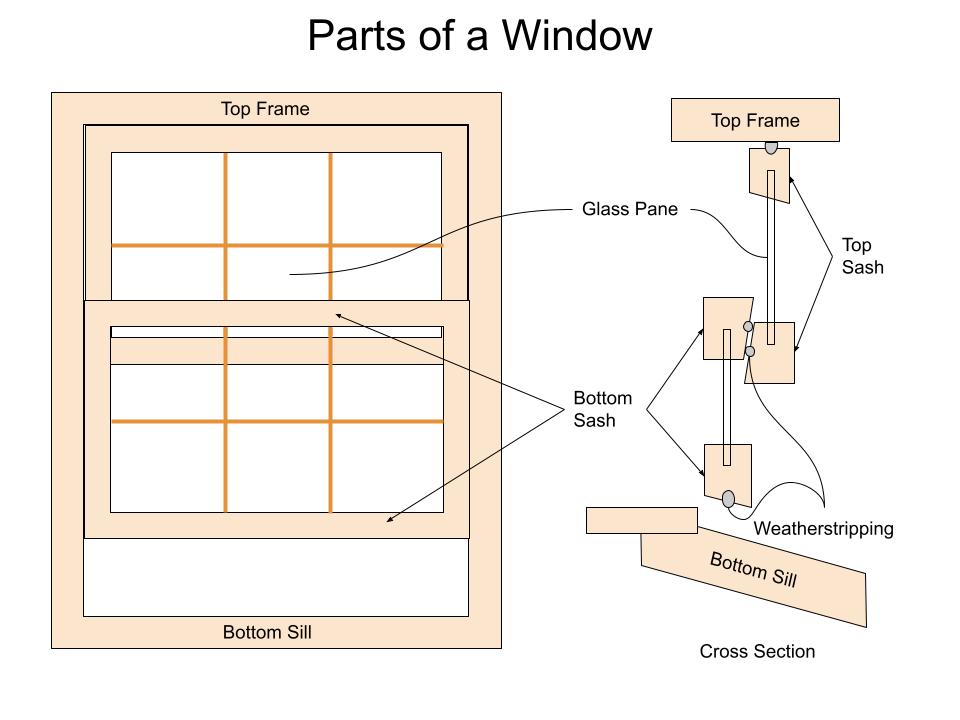
A fixed window can’t open; its sashes are fixed to the frame. A single-hung window usually has a top sash that is fixed to the frame and a bottom sash that can slide. In a double-hung window, both the top and bottom sashes can slide in the frame; a sash lock pulls the two sashes together and prevents the sashes from moving when locked. Casement windows have a hinge on one side, allowing us to pull the sash closed tightly.
A single-pane window has one sheet of glazing (usually glass) in its sashes. A double-pane window has two sheets of glazing, separated by a small air gap, and a triple-pane window has three sheets of glazing. So a photon of light trying to travel through a triple-pane window has to get through three layers of glass and across two pockets of dead air space. Nonetheless, an old-fashioned single-pane window that is firmly closed saves more energy than a modern super-efficient triple-pane window that is left open just a hair because air molecules can ferry so many photons with them if they are allowed to flow through an open window.
“Depending on the type of window, the center of the pane of glass can be the most energy efficient area on the entire window assembly.”
—Jeff Siverhus, Product Manager at Marvin
What You Need to Know About Air Infiltration
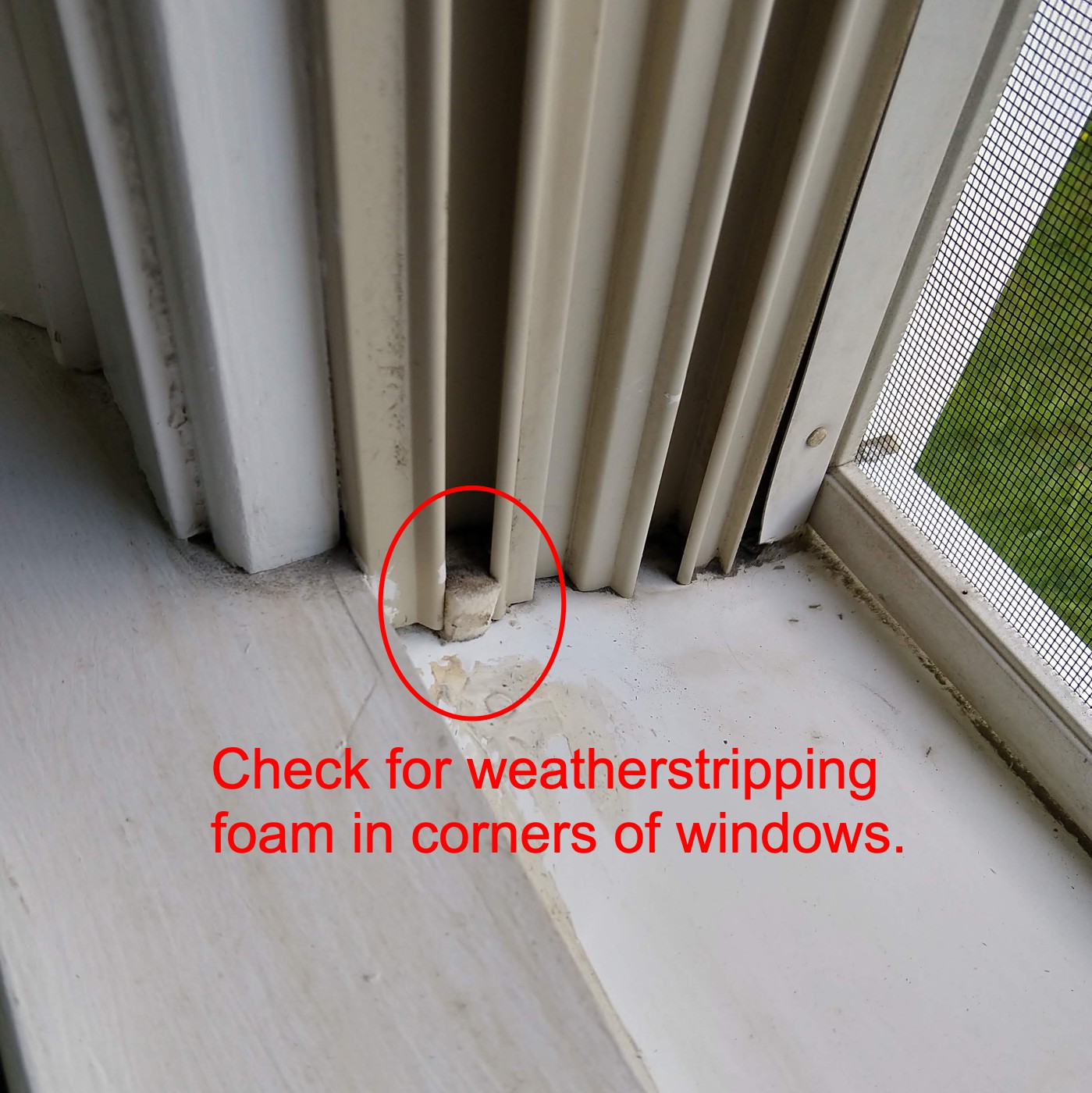
Movable sashes should have weatherstripping around their edges to reduce air flow around the sash. If you can slip a piece of paper around a sash when it is fully closed, that’s a problem. You might be able to solve it by fixing weatherstripping or replacing a sash, or if the house has settled and the frame is out of square, you might need to replace a whole window assembly.
Help! Is it better to open the windows or run the air conditioner?
If outdoor air isn’t too hot and muggy, we can save energy by opening windows and letting air currents cool us off. However, if it is hot and muggy outside, leaving windows open will not only let cool air flow out but will also allow hot air and moisture in. So the answer depends on heat and humidity. Windows can provide ventilation, but they have drawbacks—we’ll explore better ways to provide ventilation in a future action guide.
A related question is whether to open windows when running a whole-house fan. These fans can be an affordable way to ventilate and cool down our homes at night if outdoor heat and humidity levels aren’t too high. Most manufacturers recommend leaving windows open when running these powerful fans so that outdoor air comes through our windows and isn’t sucked into our homes down chimneys and flue pipes. Especially in homes with gas appliances, it can be dangerous to run a whole-house fan without knowing how air will flow into our home—opening windows several inches allows massive amounts of air to flow in.
Help! What can I do about windows that let in too much summer sun?
You can use awnings, solar shades, and blinds to keep summer sun from making your home uncomfortably hot. You can also use passive solar tricks, like overhangs and deciduous trees, that provide shade in the summer, but allow winter sun to deliver warming rays that reach into your home.
Help! How can I stop drafts around our windows?
Late summer and fall are great times to do home inspections and repairs to get ready for heating season. If you can imagine what it’s like to be in your home in winter, a cold draft next to a window may be a mix of infiltration (air flowing through the window assembly) and convection (cold air flowing in a loop inside the room). The first step is to figure out exactly what is going on, then slow down the airflow.
While we can reduce airflow by closing and latching shut our windows, we can’t prevent air flow through tiny spaces and pores between the fasteners, adhesives, and different materials in a window frame and sash. Even fixed windows that don’t open allow some air through. Infiltration is the technical term for this type of airflow.
We also can’t prevent gravity from pulling denser cold air down, forcing warm air to rise. When it’s colder outdoors than indoors, a window cools down the air near it. As this air becomes denser, gravity pulls it toward the floor, displacing warm air in the room. Convection is the technical term for this type of air flow.
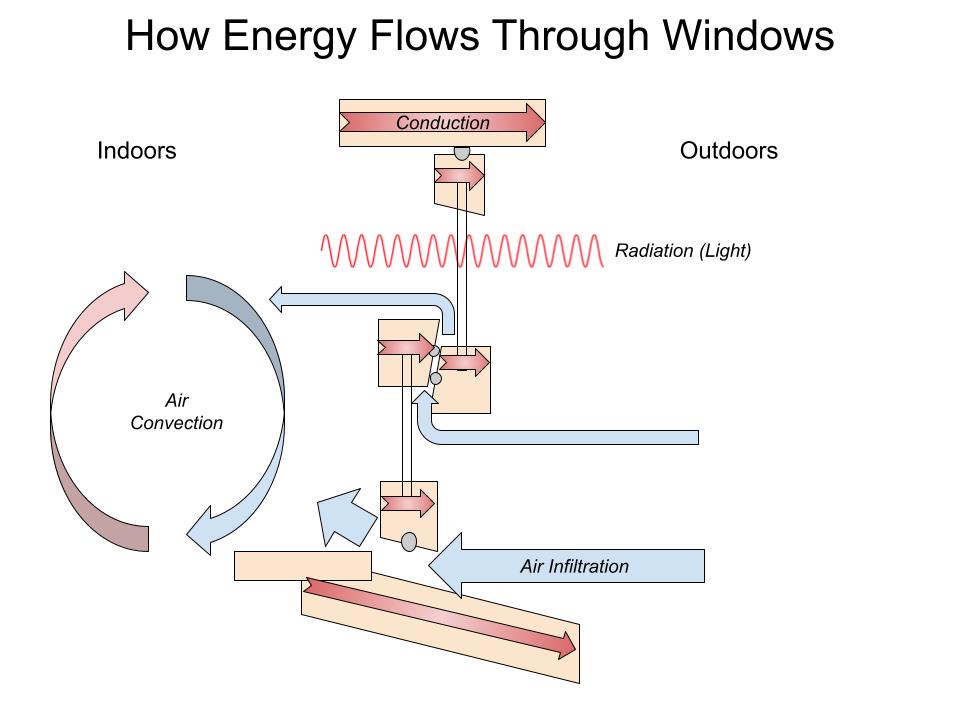
Four phenomena allow energy to flow through windows:
Conduction is energy flow through solid objects. When there is a temperature difference between outside and in, energy is conducted through the solid frame and panes of our windows.
Radiation is the transmission of energy as light or radio waves. For most windows, we want visible light to pass through their panes, but we’d like to block ultraviolet or infrared light so that not too much energy flows through.
A convection loop brings air next to the window, where it cools and sinks. The air inside the room moves around in a circle from floor to ceiling. The colder the window surface, the faster this convection flow, which happens even if no additional air at all is coming in through the window.
Infiltration is the movement of air through tiny gaps between sashes, the frame, adhesives, fasteners, and the materials in the window assembly. Cold air forces its way into our homes via infiltration into our basement and downstairs windows and pushes warm air out through our attic and upstairs windows.
If you find a cold draft next to a window, you can use the back of your hand to check if air is flowing along the sides or top of a sash. If it is, you might be able to
Close and fully latch the window.
Clean, repair, or replace weatherstripping around the window sash.

If you feel cold air flowing off the bottom sill in the middle of the window, that might be a convective loop. To solve that issue, you might be able to
Install a window treatment (insulating shades or drapes).
Install an interior or exterior storm window.
The goal with these approaches is to make the window surface warmer and trap cold air next to the window glazing rather than let cold air fall to the floor. For those of us on limited incomes, an organization like WindowDressers can help provide interior storm windows (insulating window inserts that fit snugly in a window frame to reduce air infiltration and slow convection loops) in exchange for volunteering a few hours to help measure and make them.
Help! When does it make sense to buy new windows?
Energy savings by themselves probably won’t pay for new windows—other ways to reduce heating and cooling costs (like smart thermostats, air sealing attics and basements, insulation, heat pumps, and treatments to existing windows) generally have a better return on investment. But if you’re having trouble opening or closing windows, noticing that windows are out of square, or if you are planning a major renovation and want to change the size or location of a window, that’s a great opportunity to upgrade to new, efficient windows.
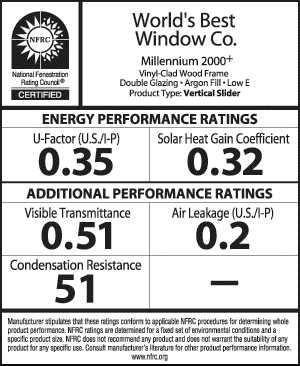
Windows with a National Fenestration Rating Council (NFRC) label are certified to deliver their rated energy performance:
U-Factor is important in any climate: the lower, the better. It measures how quickly energy flows through the whole window assembly by conduction, radiation, and convection. In general, we want a slower flow of energy. Low-emissivity (low-E) glass, multiple panes of glass, and insulation in the frames help windows achieve a lower U-factor.
Solar Heat Gain Coefficient (SHGC) is generally more important in warm climates than cold ones. It ranges from 0 to 1, measuring the ratio of solar radiation that passes through the window to the total solar radiation (ultraviolet, visible light, infrared, and beyond) arriving at the window. The lower the coefficient, the more solar energy the window blocks. In a warm climate, a low SHGC is good because the window blocks most of the sun’s energy, keeping the inside cooler. But in a cold climate, we might want a higher SHGC to allow the sun to warm up our home in winter.
Visible Transmittance is the ratio, from 0 to 1, of the visible light that passes through the window to the total visible light available. The higher this ratio, the more visible light the window lets through. The “right” value depends on whether we want to have bright daylight or to reduce glare.
Air Leakage is how much air the window allows through when closed. A perfect zero is impossible to achieve, but the closer to zero, the better.
Condensation Resistance is a scale from 1 (worst) to 100 (best), measuring how well the window resists condensation forming on its surface. This rating shows how well the window assembly—on its own, without an interior shade or insulating window insert to help—can keep its interior surface from cooling down when it’s warm inside and cool outside.
If you understand what the rating NFRC means, you can make wiser choices when you decide to invest in new windows. And there’s one more step to take to make sure every window delivers its rated performance: make sure you (for DIY projects) or your contractors install the window correctly and insulate around the frame using spray foam and caulk as appropriate. Remember that air can flow around a window more easily than through it—leaving gaps in insulation around a window frame has the same energy effect as installing a window that can never be closed all the way.
What’s Still Ahead on the Pathway…
Earlier this year, we explored the pathway to sustainable movement; now, we’re exploring the related pathway to sustainable energy. What are the best ways to save, use, and make energy? Stay with us on the journey to sustainability as we take action to have a positive impact on the world.
References and Further Reading
Windows Key to Increased Energy Efficiency in Buildings and Achieving Clean Energy Economy, US Department of Energy
Update or Replace Windows, US Department of Energy
First Steps to Endless Energy, Fred Horch
Being Sustainable, Fred Horch
What Is a Window Sash and Why Is It Important?, Champion Windows
How Low-e Glass Works, Vitro Architectural Glass
Whole House Fans: Are They Dangerous?, QuietCool
Replacing Your Windows? Don’t Do It For The Energy Savings, PV Heating & Air
Understanding Window and Door Energy Performance Ratings, National Fenestration Rating Council